
Introduction
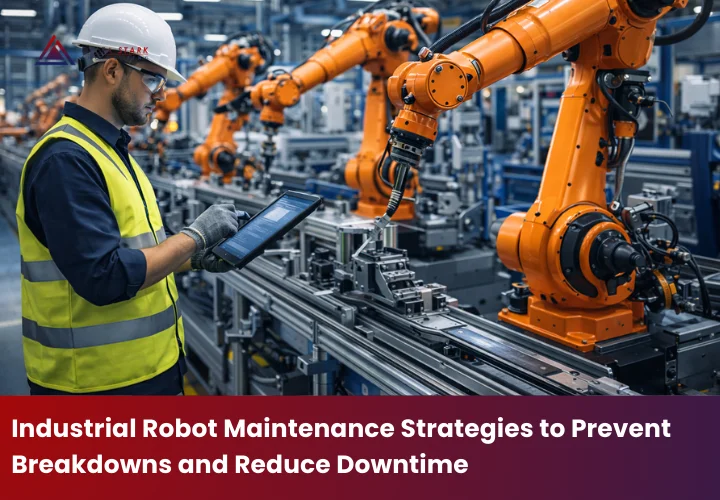
Industrial robots currently serve as essential components within manufacturing facilities. Their implementation enables businesses to operate more efficiently while delivering higher-quality products. These robots perform various essential operations, including welding, packaging, assembly, and painting, throughout their daily work schedule. Robot maintenance requires ongoing procedures just like any other type of machinery. The absence of scheduled maintenance activities will lead to industrial robot downtime. This results in production halts, which lead to substantial operational losses. Hence, businesses that utilise robots must establish straightforward maintenance methods.
Common Causes of Industrial Robot Breakdowns
Industrial robots experience breakdowns for several reasons.
The primary reason for breakdowns is the regular deterioration of equipment. The continuous use of machinery leads to material degradation, affecting parts such as joints, cables, and gears.
The absence of scheduled robot maintenance procedures represents a second primary factor for robot breakdowns. The failure to address minor problems leads to major system failures.
Dust, heat, and moisture can also damage robot parts, especially in harsh factory environments. Robots also experience operational issues because of outdated software and system faults. Another reason is power issues and improper calibration procedures, which lead to increased industrial robot downtime.
Types of Maintenance for Industrial Robots
Industries use different types of robot maintenance methods to maintain their robots.
The first is reactive maintenance. The procedure needs to fix the robot after its operational failure. This approach avoids hazardous conditions that result in extended periods during which industrial robots remain inoperable.
The second type is preventive maintenance. This process requires scheduled maintenance activities, including equipment inspection and cleaning, lubrication tasks, and replacement of parts that are likely to fail. The industrial robotics field considers this method to be common and effective for its operational requirements.
The third type is predictive maintenance. This approach uses sensors and data analytics to identify upcoming operational issues. Companies use predictive maintenance to schedule their maintenance activities while preventing unexpected equipment failures.
Role of Predictive Maintenance and Sensors
Predictive maintenance has become a widely used technology for contemporary manufacturing facilities. Smart sensors and software systems work together to track the operational condition of industrial robots. The sensors measure operational data, which includes temperature, vibration, speed and load.
Engineers use this data to evaluate robot operational performance. The system generates an alert when it detects any abnormal activity. The alert enables teams to implement solutions that prevent system failure. Predictive robot maintenance enables companies to decrease their industrial robot downtime while enhancing workplace security.
Best Practices to Reduce Industrial Robot Downtime
- Companies need to adopt basic best practices which help them decrease their industrial robot downtime.
- The first step requires organisations to establish a routine schedule for their robot maintenance activities. Organisations should conduct daily equipment inspections together with comprehensive monthly assessments of their equipment condition.
- The second step requires organisations to maintain their robots in a clean condition. Dust and dirt accumulation create a risk which leads to sensor damage and operational failure of moving components.
- The third step requires organisations to implement complete staff training programs. Operators need to learn proper robot operation procedures to report any initial operational problems.
- Organisations need to maintain a stock of spare components. The approach enables fast equipment restoration while minimising the duration of operational downtime.
- The last step requires organisations to continuously implement software and system updates for their robots to prevent operational issues.
How Proper Maintenance Increases Robot Lifespan and ROI
Effective robot maintenance will prevent equipment failures and extend the operational lifespan of industrial robots. Proper robot maintenance allows robots to operate continuously without problems for several years. This reduces the need for replacements, lowering repair costs.
The maintenance process helps businesses achieve better return on investment (ROI) results. Industrial robots experience less downtime, which results in increased production, improved operational efficiency and higher business profits. The process of robot maintenance provides organisations with both time savings and cost reductions.
Conclusion
Industrial robots function as essential components of modern manufacturing processes. However, the absence of proper robot maintenance can result in robot breakdowns, which lead to manufacturing delays. Combining an understanding of common breakdown causes with proper maintenance techniques and the implementation of predictive tools can reduce industrial robot downtime.