
Introduction
The rapid growth of e-commerce and online stores in India has greatly increased the need for faster, more precise order delivery. Firms are struggling to streamline their logistics processes to meet ever-increasing customer expectations. In this changing environment, the use of new technologies such as robotic sorting systems, automated sorting, and automated warehouses is transforming how warehouses operate and the speed at which customers receive orders.
In this blog, we discuss how robotic sorting systems are transforming order fulfilment in India, how they work, their advantages, and the future of automation in the country’s warehousing sector.
What are Robotic Sorting Systems?
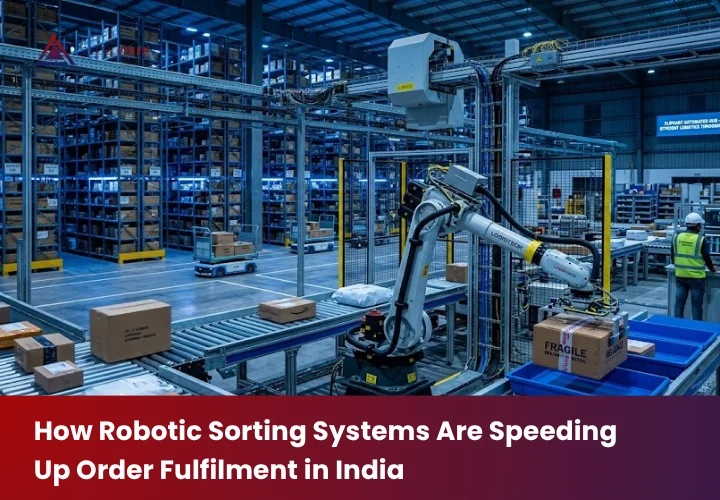
A robotic sorting system is the latest technological solution for automating the sorting of packages, parcels and goods in warehouses and fulfilment centres. Intelligent robots, sensors, artificial intelligence, and software algorithms are used in these systems to recognise, pick and sort items efficiently.
In contrast to manual systems, automated sorting relies on precise programming and real-time data, ensuring items are sent to the correct destination without delay. These systems are often integrated with larger automated warehouses, enabling smooth coordination among storage, picking, packing, and dispatch operations.
The Reason Why India Should Use Robotic Sorting for Its Order Fulfilment
The logistics and e-commerce sectors in India are experiencing a surge in growth. As the number of online shoppers grows and delivery networks expand, the traditional warehouse business is finding it difficult to keep up with demand.
A robotic sorting system is even more important in the present-day scenario because of a number of reasons:
- Increased order volumes during festive seasons and sale events.
- Growing customer demands for delivery on the same day or the next day.
- Lack of labour availability and increased workforce expenses.
- Need for accuracy when managing large numbers of packages.
To resolve these challenges, warehouse automation is being implemented in business enterprises for automating warehouses. Such technologies reduce processing time, minimise human error, and smooth operational processes, even during peak demand seasons.
How Robotic Sorting Systems Speed Up the Order Fulfilment Process: Step by Step
The effectiveness of robotic sorting equipment lies in its ability to simplify the overall sorting operation.
The step-by-step processing of their workings in a modern warehouse setting is as follows:
After the products reach the warehouse, they are barcoded or RFID scanned. The automated sorting machines recognise each product and assign it a particular destination or category.
Automated warehouses use advanced software that evaluates order details and identifies the best path for each package. This guarantees fewer delays and efficient movement in the facility.
Sensors and grippers enable robots to collect items and deliver them to the designated sorting stations. This robotic sorting system can handle multiple packages simultaneously, thereby increasing throughput.
Products are placed in various bins or conveyors according to the place of delivery. An automated sorting system is precise, ensuring every package is placed in the right place without manual labour.
Next, packages are sorted and ready to be sent out. Integration with automated warehouses enables smooth coordination with shipping systems, leading to faster order fulfilment.
Advantages of Robotic Sorting in the Indian Warehouses
Using a robotic sorting system has a number of benefits that directly affect the speed and accuracy of order fulfilment.
Some of the advantages for Indian warehouses are the following:
- Automated sorting systems save a lot of time by automating repetitive processes. Orders are sorted and shipped a lot faster than with the manual approach.
- Mistakes in human sorting may result in incorrect deliveries and customer dissatisfaction. Automation in the warehouse guarantees accurate sorting and eliminates errors.
- Indian online business websites usually experience a peak period during the festive seasons. The robotic sorting system can easily handle increased workload without compromising its performance.
- As labour costs and labour issues rise, an automated sorting system offers a safe way out by reducing reliance on manual labour.
- Integration with automated warehouses ensures efficient storage and movement, making the best possible use of available space.
- A robotic sorting system helps make the working environment safer by minimising the need to handle heavy or repetitive tasks manually.
Challenges to Consider Before Implementation of Robotic Sorting in India
Although there are significant advantages to using a robotic sorting system, there are also some challenges that businesses need to address before adopting it.
- The installation of an automated sorting system and its integration with the existing operations require a significant capital investment.
- Effective automation of a warehouse requires a well-laid-out infrastructure with sufficient space, power, and connectivity.
- Operating and servicing the robotic sorting system requires qualified personnel who can handle both software and hardware components.
- Companies must ensure that the new automated sorting system integrates with the existing warehouse management systems.
- Employees need to be trained to work alongside warehouse-automating systems, and there might be an initial adjustment phase.
Future of Robotic Sorting in India
Robotic sorting system technology in India has a bright future, supported by technological progress and the new developments in the logistics field.
There are various trends that are likely to define the future:
- Increased use of artificial intelligence for automated sorting.
- Rise of cost-effective small and medium business solutions.
- Incorporation of data analytics within automated warehouses for predictive decision-making.
- Expansion of smart warehouses in the tier 2 and tier 3 cities.
Conclusion
With the emergence of e-commerce in India, efficient order fulfilment is now more essential than ever before. Robotic sorting systems, automated sorting, and automated warehouses are instrumental in changing the way warehouse operations are conducted and in satisfying the increasing customer expectations.
Businesses that adopt automated sorting today are likely to spearhead the future of efficient and reliable order fulfilment.