
Introduction
Manufacturing automation is no longer limited to the pages of industry white papers or the plans of large enterprises; it has become an accessible reality for a wider range of manufacturing plants today. One of the most important but frequently overlooked benefits of automation is its substantial impact on the amount of raw material wasted, discarded or inefficiently used during the manufacturing process.
In this blog, we look at how automation is helping reduce material waste and the benefits for manufacturers who use automated systems in their production lines.
Understanding Material Waste in Manufacturing
It is important to understand the extent and nature of waste produced during manufacturing before exploring how automation can help solve it.
The typical issue across industries is as follows:
- Raw materials are often ordered in excess quantities or improperly measured during manual cutting, mixing and assembly operations, leading to excess scrap that is costly to dispose of or recycle.
- Manual processes are inconsistent and increase human errors, leading to poor-quality products that are irreparable or need to be scrapped.
- If not controlled carefully, energy-intensive processes require more material inputs, like coolants, lubricants or coatings, than is necessary.
The Role of Automation in Modern Manufacturing
The transition towards industrial automation is being fuelled by the broader push for Industry 4.0, which brings digital technologies, data analytics, and intelligent machines to the manufacturing process.
Here are the changes in the manufacturing industry:
- Automated systems work with precision and repeatability that cannot be matched by manual processes while helping reduce overproduction costs.
- Production managers can assess inefficiencies as soon as they happen by collecting and monitoring the data in real time instead of waiting for the end-of-shift audit.
- Today, affordable prices of robotics, computer numerical control (CNC) machining and automated material handling systems mean that they are accessible to more companies.
How Automation Helps Reduce Material Waste
Automated systems help eliminate waste in nearly all stages of the production process.
In practice, this occurs in the following ways:
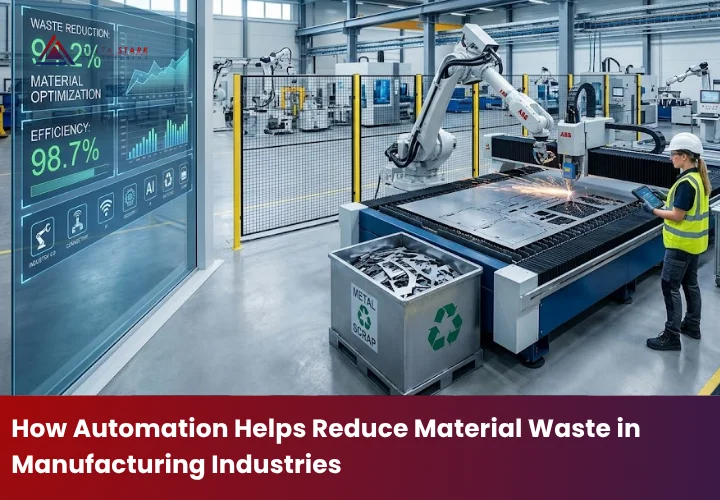
- Automated cutting machines (laser, water jet or CNC controlled) are programmed to maximise material use and minimise offcuts.
- In food processing, chemicals and pharmaceutical industries, automated dosing systems ensure that the right amount of the ingredient is used each time, avoiding overpouring and spillage typical in manual operations.
- Continuous control and adjustment of process parameters like temperature, pressure, feed rate, etc. by automation systems ensure that materials are processed under optimum conditions, minimising risk of material loss and batch failures.
Key Benefits of Reducing Material Waste Through Automation
There are other benefits of automation focused on material waste reduction as well, apart from the financial ones.
Here are some of the broader advantages:
- Reducing the raw material usage per unit produced enhances gross margins, especially in industries where the material costs are a substantial percentage of the total cost of goods.
- Minimising waste helps manufacturers comply with environmental legislation, carbon reduction goals and increasing customer and investor satisfaction, who value responsible production.
- Disposal costs of scrap, offcuts and rejected batches are reduced, which also helps meet the regulatory requirements in certain industries.
- When material input is efficiently used and processes are well-controlled, product quality is much more consistent and the number of product returns and warranty claims also reduces significantly.
Future Trends in Manufacturing Waste Reduction
Going forward, industries will focus on combining automation with sustainability in manufacturing plants.
Here are some of the biggest anticipated trends in the future:
- Artificial intelligence is being used to find waste patterns that are not immediately obvious to human operators by analysing production data.
- Manufacturers have started using digital replicas of their production environments to test process changes before making the final decision.
- Cobots, intended to collaborate with human workers, are used for jobs that require both accuracy and flexibility.
- Automation is also helping manufacturers in recovering, sorting and reprocessing their scrap and offcuts better so they can be used again in the production process.
Conclusion
Manufacturing automation is not just enhancing the production rate but also making it smarter, leaner and much less wasteful. Smaller manufacturers who recognise this and take action on it in 2026 will set the standards for the rest of the industry.
Contact us today to learn how automated systems can be customised to help solve waste reduction issues in your particular manufacturing process.