
Introduction
If you run a small factory in Pune, Coimbatore, Ludhiana or Rajkot, you have probably heard the pitch: “Automate or fall behind.” Labour is harder to retain, buyers want consistent quality, and margins are thin. Robots look like the answer. But which kind? The choice between cobots and traditional industrial robots can decide whether your investment pays back in a year or sits idle in a corner.
Let’s break it down in plain language.
What Is a Cobot?
A cobot (collaborative robot) is a robotic arm designed to work alongside humans without heavy safety fencing. It has force and torque sensors, so it stops or slows when it touches something unexpected. Most cobots can be taught by hand: you move the arm to the positions you want, and it remembers them. They typically handle payloads from about 3 kg to 30 kg.
Common jobs: machine tending (loading CNC or injection moulding machines), screw driving, pick and-place, packing, light welding, polishing and quality inspection.
What Is a Traditional Industrial Robot?
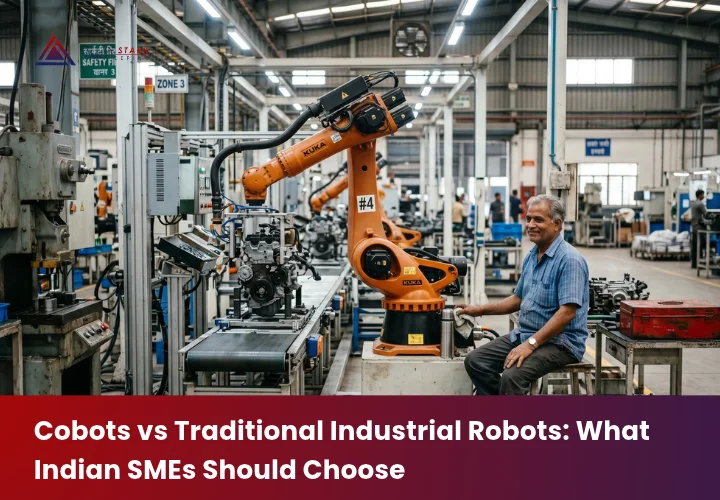
Traditional industrial robots are powerful, very fast arms built for repetitive, high-volume production. They can lift hundreds of kilograms and repeat motions with extreme precision. The catch: they are dangerous around people, so they sit inside safety cages with light curtains and interlocks, and they usually need trained programmers.
Which One Fits an Indian SME Better?
Three realities of Indian manufacturing tip the scale towards cobots.
1. Product variety is high
Many SMEs are job-shops or supplier units serving several customers. A cobot can be reprogrammed on Monday for one part and moved to a different machine on Wednesday.
2. Space is tight
Factory sheds in industrial estates rarely have room for a caged robot cell. A cobot on a mobile stand fits beside an existing machine.
3. Skilled robot programmers are scarce
Your own operator can often learn cobot basics in a few days rather than hiring an expert.
Here is a simple example. Imagine a 40-person auto-component shop in Pune that loads parts into a CNC machine by hand across two shifts. A cobot fitted beside that machine can keep it fed through lunch breaks and night shifts, while the operator moves on to inspection and setup. The result is steadier output without rebuilding the shop floor.
What Does Automation Really Cost?
As a rough guide, a cobot arm may start from around ₹8–10 lakh, while a complete working cell with gripper, mounting, and integration commonly lands between ₹15 and ₹30 lakh depending on the task. A traditional robot arm can look similar in price, but safety cages, controllers, fixtures and specialist integration often push the total much higher. Prices vary by brand, payload and supplier, so always get at least three quotes.
Many SMEs report payback within 12 to 24 months when a cobot replaces one or two shifts of repetitive work. Treat that as a target to test, not a promise: run your own numbers using shift hours, rejection rates and overtime costs.
When Traditional Industrial Robots Still Win
Don’t write them off. Choose a traditional robot if:
- You run the same part for years at very high volumes.
- Cycle time is critical and every second counts.
- Parts weigh well over 30 kg.
- You are a tier-1 supplier with a dedicated, fenced production line.
Common Mistakes Indian SMEs Make
- Buying for the dream, not the task. Automate one clear, repetitive job first.
- Ignoring the gripper and fixtures. The arm is only half the system. The tooling decides whether it works.
- Skipping the risk assessment. “Collaborative” does not mean “automatically safe.” A sharp part or a fast-moving tool can still hurt someone. Follow the industrial safety standards
- Forgetting the people. Involve operators early. Moving them to supervision and quality work builds trust and avoids resistance.
How to Decide: A 5-Step Checklist
- List your repetitive tasks such as loading, packing, screwing or inspecting.
- Check payload and reach. Weigh the heaviest part plus the gripper.
- Count your product variants. More variety favours cobots.
- Calculate cycle time needs. If the robot must be faster than a human by a wide margin, look at industrial robots.
- Run a pilot. Ask suppliers for a demo on your actual part before you commit.
FAQs
Are cobots slower than industrial robots?
Yes, generally. But in many SME jobs the robot’s real advantage is working steadily across shifts, not raw speed.
Can a cobot work without a safety cage?
Often yes, but only after a proper risk assessment of the whole application, including the tool and the part.
Will cobots replace my workers?
Most SMEs use them to take over dull, repetitive work so people can focus on setup, quality checks and skilled tasks.
How long does installation take?
A simple cobot application can be running in days to a few weeks. A traditional robot cell often takes longer.
Conclusion
For most Indian SMEs, cobots are the lower-risk first step into automation: affordable, flexible and easy to learn. Traditional industrial robots remain the right tool for heavy, fast, high-volume work. Start with one task, measure the results, and scale from there.
Thinking of automating a process in your plant? Pick one repetitive task this week, time it, and ask two suppliers for a demo. That small step will tell you more than any brochure.