
Introduction
The food packaging industry is undergoing significant change as manufacturers face growing pressure to minimise waste, improve precision, and meet increasing consumer demands for quality and sustainability. This is where intelligent automation is bringing a change.
This blog discusses how AI robotic vision systems are changing the nature of the modern packaging lines.
Challenges in Traditional Food Packaging Processes
Traditional food packaging frameworks are susceptible to several constraints that directly affect productivity and profitability. Manual inspection can be unreliable, leading to undetected defects or unnecessary product rejection.
Differences in shape, size, colour, and texture also complicate the process, particularly for fresh or irregular products.
What Are AI-Powered Robotic Vision Systems?
AI-controlled robotic vision systems use high-resolution cameras, advanced sensors, and machine learning algorithms to enable machines to “see” and perceive the world around them. AI-based vision systems learn from data and can adapt to different products and surroundings, as compared to traditional systems that use fixed rules.
They use visual data at high speeds to detect defects, verify labels, check seals, and control robotic arms with high accuracy.
Role of Robotic Vision Systems in Food Packaging Lines
Robotic vision systems are vital in various processes of food packaging lines.
They usually fill the following role:
- Checking items for defects or contamination.
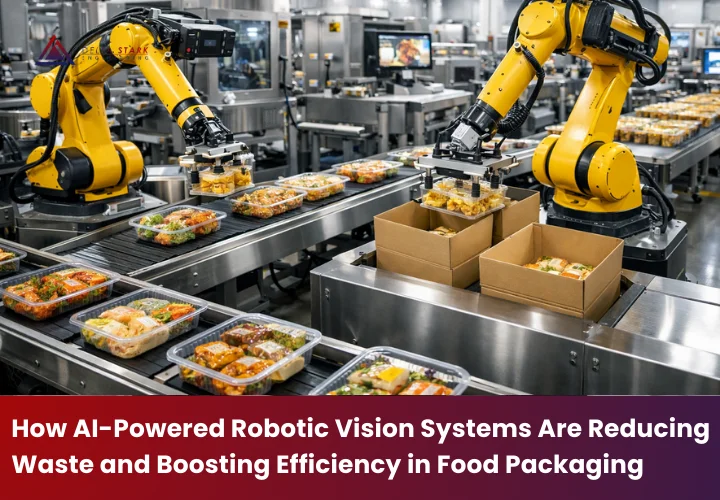
- Guiding packaging robots in pick-and-place operations.
- Checking the integrity of packaging and label accuracy.
- Monitoring consistency in portioning and alignment.
Key Applications in Food Packaging
Some of its most important applications are:
- Quality check: Detecting damaged packaging, incorrect seals, or foreign objects.
- Sorting and grading: Organising products by size, colour, or quality.
- Label verification: Checking for positional accuracy, readability and compliance.
- Tray and carton loading: Proper product positioning to prevent damage.
How AI Vision Systems Reduce Packaging Waste
One of the greatest benefits of AI-driven vision systems is waste reduction. They can identify faulty products early and precisely so they cannot move further down the line, where correcting the faults will be more costly.
Precise visual guidance also guarantees accurate filling, cutting and sealing and minimises the overuse of packaging materials. Also, the number of false rejections is reduced, meaning good products are not unnecessarily discarded.
How AI Vision Systems Improve Operational Efficiency
The benefits of AI vision systems go beyond waste minimisation. These systems operate at high speeds without fatigue, and thus they can inspect and handle continuously without reducing production.
Key efficiency advantages are:
- Shorter cycle time with consistent accuracy
- Minimised downtime due to early fault detection.
- Lower dependence on manual labour with food packaging automation.
- Improved line flexibility for product changeovers
Data Insights and Continuous Process Improvement
Along with making real-time decisions, AI vision systems produce valuable data that can also be used to optimise processes in the long term. Visual inspection data may reveal recurring faults, machine misalignments or inefficiencies in upstream processes.
Through these insights, manufacturers can:
- Identify the root causes of quality problems.
- Optimise machine settings and processes.
- Predict maintenance needs before failures occur.
Integration with Packaging Machines and Control Systems
Modern AI vision solutions are developed to be compatible with the current packaging machines and control systems. They can communicate with programmable logic controllers, robotic arms and enterprise systems to coordinate actions across the line.
Such integration makes packaging automation responsive and cohesive so that it can be adjusted quickly without having to reconfigure the entire system. Consequently, manufacturers can implement AI vision incrementally to get the most out of the investment.
Future Impact of AI Vision in Food Packaging
Robotic vision systems are expected to become even more intelligent and autonomous as AI technology advances. Future developments may include self-learning systems that adjust immediately to a new product, improved cooperation between humans and robots, and deeper integration with supply chain analytics.
As sustainability, traceability, and efficiency gain increasing importance, AI-driven vision will take centre stage in designing the next generation of food packaging plants.
Conclusion
AI-enabled robotic vision systems are redefining what is possible in modern food packaging. They solve most of the problems that have afflicted the industry over the years by improving accuracy, reducing waste and boosting efficiency.
The integration of intelligent vision and packaging robots will improve the operational performance while also supporting more sustainable and resilient food packaging operations as manufacturers continue to invest in smart technologies.