
Introduction
It’s crucial to choose the right conveyor system that aligns with your production requirements without negatively affecting operations. The right conveyor system facilitates industrial operations, reduces manual labour, and improves warehouse logistics speed and efficiency. This blog focuses on the types of conveyor systems and why industries should invest in the right conveyor machinery to avoid downtime and delayed production.
What Is a Conveyor System?
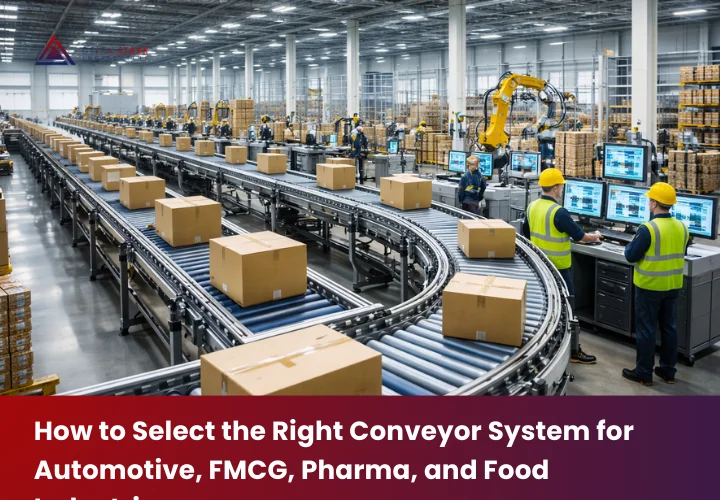
A conveyor system is a mechanical handling equipment used for moving materials from one place to another. The equipment uses moving surfaces, such as belts, chains, or rollers, to maintain a continuous flow of materials. Industrial conveyor systems streamline operations by allowing the smooth movement of bulky goods along fixed paths.
Types of Industrial Conveyor Systems
Each conveyor has its own pros and cons, and their choice depends upon the type of operations they are used in. Here are a few of them:
- Belt conveyor: Also referred to as conveyor belts, this is the simplest form of belt system conveyor that moves commodities from one place to another. This type of conveyor is used in every industry and includes pulleys and a closed-loop conveyor belt.
- Chain conveyor system: Here, a continuous chain is used to move the bulky materials that glide over sprockets located at the two ends. They are best suited for transferring materials that are extra wide and long.
- Cable conveyor system: They are energy-efficient material handling conveyors where a coated stainless steel cable navigates through a sealed tube. These versatile conveyor systems are zero-maintenance and allow consistent product blending with minimum product degradation.
Why Conveyor Selection Differs by Industry
The choice of conveyor system for industries is quite challenging as no one-size-fits-all solution. While the automotive industry demands conveyors that are heavy-duty and strong, the FMCG industry looks for high sanitary standards, and material handling systems that are low-maintenance. Conveyor selection varies widely for industries and operational goals, and hence, must be carried out wisely for sound production.
Conveyor System for the Automotive Industry
The automotive industry refers the following types of industrial conveyor systems:
- Roller conveyors: Best for moving heavy components like engines and machinery assemblies.
- Overhead conveyors: Made for the transportation of car bodies and bumpers.
- Belt conveyors: Used for carrying relatively smaller loads
Conveyor System for FMCG Industry
FMCG industries demand conveyors that offer high speed automated transport and sorting and packaging of goods. Some common types of conveyor used are modular belt conveyors, food-grade PU/PVC belt conveyors, and table-top conveyors.
Conveyor System for the Pharma Industry
The pharma industry relies heavily on conveyor systems that are designed for hygiene and contamination prevention. They are expert in transporting fragile goods and streamlining accurate and sterile operations. Some of the conveyor systems used by the pharma industry are belt and roller conveyors and vacuum/pneumatic conveyors.
Conveyor System for the Food Industry
Food-grade conveyors are easy-clean designs that prevent contamination and bacterial growth. Modular belt conveyors, vibratory conveyors and screw conveyors are a few of the most commonly used conveyor systems in the food industry.
Key Factors to Consider Before Choosing a Conveyor System
The right conveyor selection depends on many factors, including:
- Product specification: Includes product weight, type, height, length, and width of the product
- Space availability: One needs to consider the space availability like ceiling height and floor space
- Energy consumption: It’s crucial to consider the product’s overall energy requirements and the duration of the journey to its destination.
- Cleaning and maintenance: Maximum hygiene level and minimum maintenance cost is the motto for a perfectly running conveyor system.
- Cost effectiveness: Investing in the right equipment will support in the long run without added repair and maintenance costs.
Common Mistakes While Selecting a Material Handling Conveyor
Avoid these common mistakes while choosing a material handling conveyor:
- Ignoring the material size and volume.
- Not calculating peak load requirements.
- Overlooking environmental factors and weather extremes.
- Neglecting maintenance accessibility.
- Disregarding energy efficiency.
Conclusion
Delta Stark Engineering offers customised material handling conveyors that are designed for efficiency, durability and automation. Our products are based on specific industry obstacles and promise an improved safety by minimising manual material handling. We are a one-stop shop for your conveyor needs and also offer expert advice and exceptional customer service to boost your operations.