
Introduction
With the growth of the middle class and the increasing urban population, the need for high-quality, tamper-evident and eye-catching packaging has never been greater. The days of simple adhesive labels are gone; today’s Indian consumers want quality and hygienic packaging. The solution to meet these modern requirements is in-mould labelling (IML), which seamlessly improves production speed while supporting brand expression.
In this blog, let’s dive deep into the impact of IML robots’ food and beverage packaging systems on manufacturing plants in India.
The Shift of Food and Beverage Packaging in India Towards IML Robots
Traditional glue-applied labels are often affected by India’s varied climatic conditions, which can cause them to peel or mould. IML technology forms a permanent bond – from the factory all the way to the fridge.
These safety standards help manufacturers develop clear guidelines that minimise these risks and ensure safe collaboration between humans and machines.
To understand why this shift is important, consider the following benefits:
- The process is completely automated, with limited human contact, which is essential for ensuring the safety standards required for dairy products and ready-to-eat foods.
- High-resolution graphics are embedded into the plastic, preventing scratching, fading or moisture damage during transportation.
- While an initial investment is required, the reduction in waste and the removal of secondary labelling processes lead to a lower per-unit cost.
- Containers and labels are usually made of the same material, polypropylene, so there is no need to separate the components during recycling.
The Working Principle of the IML Robot in a Food Packaging Production Line
The modern robotic systems have several safety features to avoid accidents and ensure smooth working.
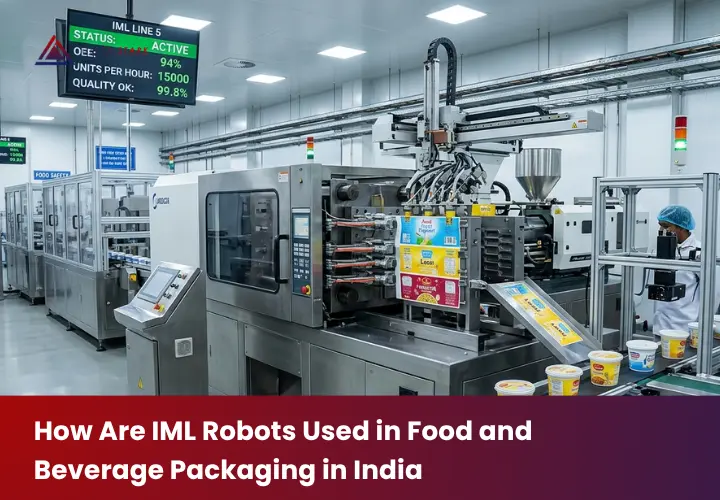
The work of an IML robot in food packaging automation happens in a cycle that often lasts less than ten seconds. It starts with the robot picking up a pre-cut, die-cut label from a magazine. It is equipped with a sophisticated vacuum or electrostatic system that ensures the label is held firmly as it enters the high-pressure mould environment.
The steps involved in a standard IML robotic cycle are:
- The robotic arm retrieves the label from a stack using a specialised end-of-arm tool (EOAT) so that one label is retrieved at a time.
- The robotic arm is then used to place the label against the cavity wall with millimetre accuracy.
- A high-voltage charge is applied to the label, which adheres to the metal mould wall due to static charge.
- The robot retracts, the mould closes, and molten plastic is injected, fusing the label to create a single, solid piece.
- Once cooled, the mould is opened by the robot (or a second arm), and the manufactured product is retrieved and stacked for quality assessment.
Which is the Most Suitable IML Robot for Food and Beverage Packaging Lines in India?
Selecting the right robotic system depends on your production line’s requirements.
When considering which IML robots meet your facility’s requirements for food and beverage packaging systems, consider the following:
Workers interacting with robotic systems should be provided with training on:
- When choosing between side-entry vs top-entry beverage packaging robots, remember that it primarily depends on speed and flexibility requirements.
- Make sure that your robot can carry the weight of your labels and tools while reaching the maximum depth of your moulding machine.
- You need to ensure the robot’s control system integrates seamlessly with your current injection moulding equipment to avoid timing issues.
- Given the technical nature of automation, working with a consultancy with a strong service presence in India is essential to ensure optimal uptime.
- Robustness is as crucial as speed in the Indian market, where power fluctuations and dust can be a major concern.
The Future of IML Robots in India’s Packaging Sector
The packaging industry in India is progressing towards a digital future. Packaging robots are now becoming “smart factory” robots with artificial intelligence (AI) to correct any defects in the production process. Sensors can detect even slight misalignments on a label and correct the robot’s coordinates in real time.
This level of precision will help Indian manufacturers compete in the international market and export high-end packaged goods to Europe and North America with confidence.
Last Thoughts
IML robots for food and beverage packaging increase food safety and improve the efficiency of packaging lines. Although packaging automation seems complex, the long-term benefits, such as brand loyalty and waste reduction, are definitely worth the upgrade. Invest in IML robots today to automate your industrial processes and enjoy reliable performance with minimal maintenance.