
Introduction
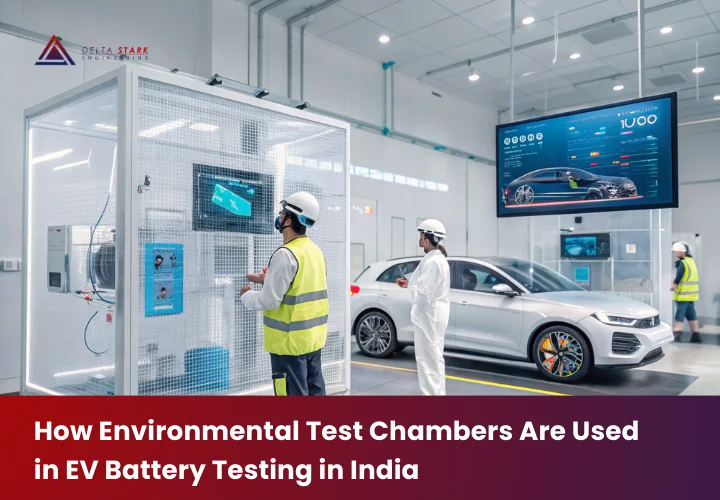
The high-paced growth of electric vehicles in India has brought intense attention to the safety, reliability, and performance of EV batteries. And environmental test chambers play a critical role in validating the safety, performance and durability of these EV batteries. In this blog, we discuss why environmental test chambers are crucial in battery testing in India.
What Are Environmental Test Chambers?
Environmental test chambers are specialised facilities that replicate different environmental conditions in controlled settings.
These chambers recreate high temperatures, humidity, vibration, and other effects of the natural environment to determine the functionality of products in real-world conditions.
Environmental Conditions Simulated for EV Battery Testing in India
The climate in India varies widely across regions, making it necessary to test EV batteries across multiple environmental conditions.
Some of the key conditions that are simulated during battery testing are:
- Extreme heat: Batteries are put under high temperatures to test their thermal stability and ability to withstand overheating.
- Humidity Testing: Environment test chambers are used to test corrosion hazards and the effectiveness of insulation in high-humidity environments.
- Thermal Cycling: The process of exposing batteries to alternating high and low temperatures. It is used to find out the nature of the expansion and contraction of battery materials with time.
- Vibration and Stress Testing: There are chambers that recreate vibrations and physical stress to ensure the structure is durable.
How Environmental Test Chambers Are Used in EV Battery Testing (Step-by-Step Process)
EV battery testing in test chambers is conducted using a well-organised, closely supervised procedure.
- Battery preparation: During the test, sensors are fitted to monitor parameters such as temperature, voltage, and current.
- Placement within the chamber: The battery is installed in the test chamber, where environmental factors such as temperature and humidity can be accurately regulated.
- Establishing test conditions: Engineers set specific environmental conditions based on the aim of the testing.
- Performance monitoring: In battery environmental testing, complex systems track battery behaviour in real time.
- Analysis and evaluation: When the testing cycle is over, the engineers analyse the obtained data.
Benefits of Using Environmental Test Chambers in EV Battery Testing
Environment test chambers provide a number of benefits for battery testing and, therefore, are necessary in the EV manufacturing ecosystem.
By using battery environmental testing, possible risks to human safety, like overheating or thermal runaway, can be detected prior to battery installation in cars.
Exposure to extreme conditions during testing of the battery gives a chance to verify consistency in the actual conditions.
The reason behind testing is to make sure that EV batteries are safe and efficient and meet the safety and performance standards required by the regulatory authorities.
Challenges in EV Battery Environmental Testing in India
Although the use of environmental test chambers is on the rise, EV battery environmental testing in India faces a number of challenges.
- Advanced testing facilities are expensive to set up due to the high investment required in equipment and technology.
- EV battery technologies continue to evolve rapidly, which means testing systems must continually adapt to new battery chemistries and designs.
- EV batteries used nowadays have several testing parameters, and this makes the testing process more complicated and time-consuming.
Growing Demand for Environmental Test Chambers in India’s EV Industry
As more people adopt electric vehicles, there is an increasing demand for environmental test chambers in India.
Automotive companies, battery manufacturers and research institutes are working on battery testing facilities to ensure safety and performance.
Future Trends in EV Battery Testing in India
Technological innovation and high safety standards are expected to become the key factors shaping the future of battery testing in India.
Some of the new trends are:
- Artificial intelligence can be used to analyse test data more quickly and predict battery performance.
- As the EV market matures, industry testing standards will become more defined.
- The testing methods will evolve to support new battery technologies like solid-state batteries.
Conclusion
Environmental test chambers have emerged as an important tool for ensuring that EV batteries can withstand various environmental factors and deliver consistent performance. Environmental testing, thus, assists in creating safer, more reliable electric vehicles for the future.