
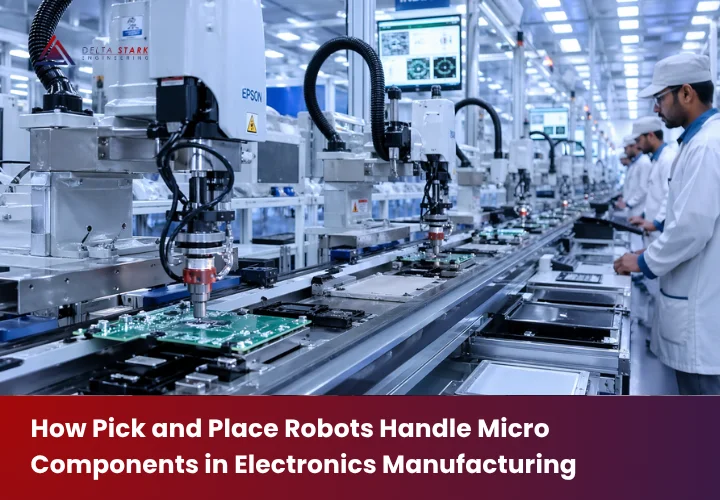
The electronic devices manufacturing sector has been developing at a fast pace, and the devices have become smaller, faster, and more complicated. Whether it is smartphones or medical devices, the need for accuracy and efficiency has increased significantly. To satisfy these needs, electronic industries need high levels of automation, like pick-and-place robots that are used to place even the smallest components on the circuit board correctly.
This blog discusses the role played by pick and place robots for electronics in modern manufacturing, especially in microcomponent handling in electronics, and how the production and assembly of electronics are being revolutionised by robotic assembly lines with precision, speed, and reliability.
Why Does Electronics Manufacturing Need Specialised Pick-and-Place Robots?
The contemporary electronic devices are designed with small and fragile components, measured in just micrometres. It is not only difficult to handle such components manually, but it is also liable to human error, making automation necessary.
These are the main reasons why electronics require specialised pick-and-place robots that
- Electronic components like resistors, capacitors and integrated circuits are progressively becoming smaller, requiring extremely accurate microcomponent handling in electronics.
- Manufacturers must use effective robotic assembly lines to produce thousands of units of products within strict deadlines.
- Human handling may cause variation, but the pick and place robot has a consistent accuracy for placement.
- Static electricity or mishandling may destroy sensitive electronic parts, which is minimised by advanced robotic assembly lines.
The current PCBs need precise placement of parts within densely packed layouts, and therefore micro-component handling is essential in electronics.
The Step-by-Step Process of How Pick and Place Robots Work with Micro Components
Handling microcomponents in electronics is a process that consists of several steps, each of which is meant to ensure accuracy and efficiency.
A step-by-step description of the way pick-and-place electronics robots work is given below:
The robot recognises the precise position and orientation of the component and the type of component using sophisticated vision systems. This ensures proper microcomponent handling in electronics even at high speeds. Moreover, machine learning algorithms can also enhance the accuracy of detection with time by comparing patterns and changes in components.
The robot picks tiny parts with the help of specialised nozzles or grippers. These are special tools designed specially for delicately handling parts in robotic assembly systems. The gripping mechanism is also tuned carefully to exert the right force, which does not cause any physical harm to the delicate components.
After being picked, the component is properly oriented using sensors and cameras. This step plays a vital role in pick-and-place robots for electronic parts to be perfectly placed. Any slight misalignments are fixed in real time, and each part is fitted into its place in the circuit design.
The robot accurately puts the part on the printed circuit board at the required position. Electronics have high-speed motors and controllers that make sure that the handling of micro-components is accurate. This is coordinated with conveyor systems so that the production line works smoothly.
Once it is placed, it is checked by automated inspection systems to check the accuracy and position. This makes sure that robotic assembly lines meet high quality standards. Detected errors are notified instantly, and corrective measures are taken without disturbing the whole production process.
Pick-and-place electronic robots are effective in large-scale manufacturing since these robots can be operational at all times with minimum downtime. Their ability to operate 24 hours enhances the throughput and helps meet the strict manufacturing deadlines.
Advantages of Pick-and-Place Robots in Electronics Manufacturing
Incorporating pick and place robots in the electronics manufacturing process has many benefits that improve productivity and quality.
The most significant advantages:
- Advanced vision systems and sensors allow micro component handling in electronics with high precision, hence minimising mistakes in placement.
- Robotic assembly lines can operate at high speeds, and therefore, their output is significantly high as compared to manual processes.
- Consistent positioning brings uniformity that improves the overall quality of electronic products.
- Although the initial cost of the pick-and-place robots for electronics can be expensive, it reduces labour costs and also minimises wastage.
- Automation reduces reliance on manual labour as workers can concentrate on other more complex tasks.
- Microcomponents handled may result in strain or exposure to hazardous materials, which is reduced using robotic assembly lines.
Challenges in Implementing Pick-and-Place Robots
Despite the benefits they offer, there are some challenges associated with the integration of pick-and-place robots in the manufacturing processes of electronics.
Manufacturers are likely to encounter these issues:
- The installation of modern robotic assembly lines is costly.
- These systems need to be operated and maintained by skilled individuals who have knowledge of handling microcomponents in electronics.
- Adding new pick-and-place robots for electronics into existing production lines can be complex.
- Routine maintenance is needed to ensure optimum performance of the robotic assembly lines.
- Changes in the designs of products require flexible systems that can handle a range of electronic microcomponents as needed.
Future Trends in Pick-and-Place Robots
With the evolution of industries, there are a number of trends that are defining the next generation of robotic assembly lines.
The following are some of the trends to look for:
- AI systems will improve decision-making and handling of microcomponents in electronics.
- Better imaging technologies will assist in better identification and placement by pick-and-place robots in electronics.
- Smaller and more efficient robots will be used in more complicated robotic assembly lines.
- Electronic robots will work with humans to make the process of handling microcomponents more productive and flexible.
- Pick-and-place robots for electronics will be optimised and monitored in real-time using connected systems.
- The next generation of robotic assembly lines will minimise energy usage and the effect on the environment.
Conclusion
With the increase in complexity of electronic devices, precision and efficiency have become more significant than ever.
The use of technologies like pick and place robots for electronics has proved to be critical for correct and consistent handling of microcomponents in electronic production, thus enabling manufacturers to handle high production requirements with minimal effort.