
Introduction
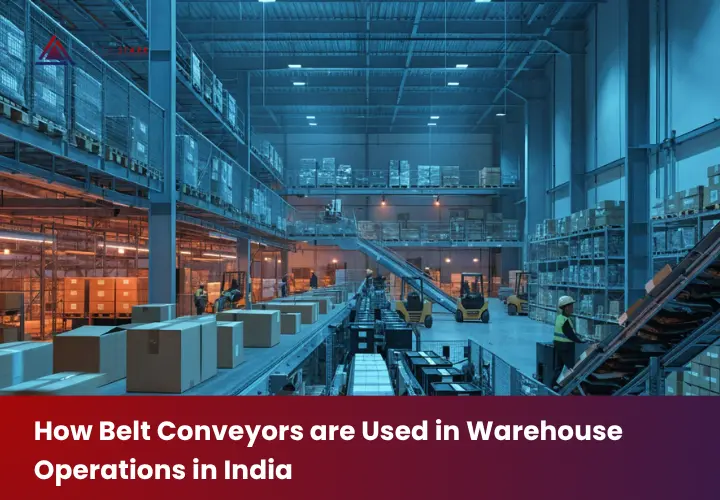
In India, the warehousing industry has undergone a significant transformation, fuelled by the growth of e-commerce, industrialisation, and organised retail. The belt conveyor is at the core of this growth, as its nationwide use ensures that operations remain efficient, reliable, and increasingly automated to meet tight delivery timelines and high order volumes.
This blog discusses belt conveyor warehouse operations, the types of belt conveyors, their advantages and how to select the right belt conveyor system for your warehouse.
Belt Conveyors and Their Importance in Warehouses
A belt conveyor is a mechanical system that transports goods, parcels, or raw materials from one place to another along a continuous looped belt, generally made out of rubber, PVC, or fabric. These systems are powered by electric motors and supported by rollers or a flat surface below, allowing them to transport goods horizontally, up an incline or even vertically between different levels of a warehouse.
In large fulfilment centres, daily dispatch volumes run into tens of thousands of units, so relying solely on human labour leads to bottlenecks, errors, and safety risks. By implementing a conveyor system, all of these challenges are simultaneously addressed, ensuring efficient and consistent movement of goods within the warehouse.
What are the Applications of Belt Conveyors in Indian Warehouses?
In an Indian warehouse, a warehouse conveyor may be used in a wide range of functions.
Typically, they are for:
- Supplier goods are automatically routed to the correct storage area at the receiving bay by placing the goods on the conveyors.
- The material is conveyed with totes or bins along picking aisles, allowing workers to place picked items directly on the belt, eliminating the need to walk long distances.
- The packed parcels travel via conveyor from packing stations to the dispatch area, where they are sorted by delivery route/dispatch.
- Returned items are fed onto conveyors and directed to inspection/restocking areas with minimal manual handling.
- Inclined or spiral belt conveyors are used to transport items between different floors of a multi-level warehouse efficiently.
What Type of Belt Conveyor is Used in Which Warehouse Function?
Not all types of conveyors are built the same way.
There are different configurations to meet different operation requirements:
Flat belt conveyors are suitable for general-purpose transportation of boxes, polybags and cartons across horizontal stretches.
An inclined belt conveyor is suitable for transporting items between different elevations and can be used in warehouses with mezzanine floors.
Cleated belt conveyors have raised areas on the belt surface that help carry loose or bulk materials that might otherwise slide.
What are the Advantages of Belt Conveyors in Indian Warehouses?
A warehouse conveyor system offers numerous benefits:
- Conveyors consistently transport products at higher speeds, allowing more orders to be processed per shift.
- Repetitive transportation tasks are automated, freeing staff to focus on more valuable tasks such as quality control or customer return management.
- Belt conveyors equipped with barcode scanners and sortation systems can significantly reduce misrouting and picking errors.
- Conveyor systems address one of the main concerns in large distribution systems: the need for manual lifting and carrying.
- Belt conveyor systems are a long-term investment, as they can be expanded, reconfigured or upgraded as the warehouse expands over time.
How to Select the Right Belt Conveyor for Your Warehouse?
To select the right conveyor, several factors must be considered.
Consider the following factors before making the final decision:
- Think about the size, weight, shape and fragility of the most frequently handled objects. A conveyor for heavy cartons may not be suited for polybag shipments.
- Before specifying conveyor dimensions and configurations, measure the available floor area, ceiling height and traffic flow.
- Calculate your peak and average daily order volume to ensure the system you choose can comfortably handle demand without becoming a bottleneck.
- Ensure that the equipment complies with the relevant industrial safety standards, including emergency stop mechanisms and guarding.
Last Thoughts
Increase your operational efficiency and enhance workplace safety with the versatile belt conveyor system. As Indian facilities increase their focus on automation, belt conveyor warehouse operations are increasingly being adopted by warehouses across the country. If you’re considering upgrading your facility, consult with a conveyor solutions expert to take the first step towards a smarter, faster warehouse today.