
Introduction
Quality inspection is an important part of manufacturing. Before a product reaches a customer, it must meet required standards. Even a small defect can cause complaints, wasted materials, product failures, and financial losses. Manufacturers need reliable ways to find problems and maintain quality.
Manufacturers also need to consider customer expectations and industry standards. A dependable inspection process protects the brand and helps ensure that products perform as intended. The goal is not simply to find faults, but to prevent repeated problems and build trust.
Traditionally, workers checked products manually. Today, machine vision helps automate many tasks. Both methods have advantages, and the right choice depends on production goals.
What is Manual Inspection in Manufacturing?
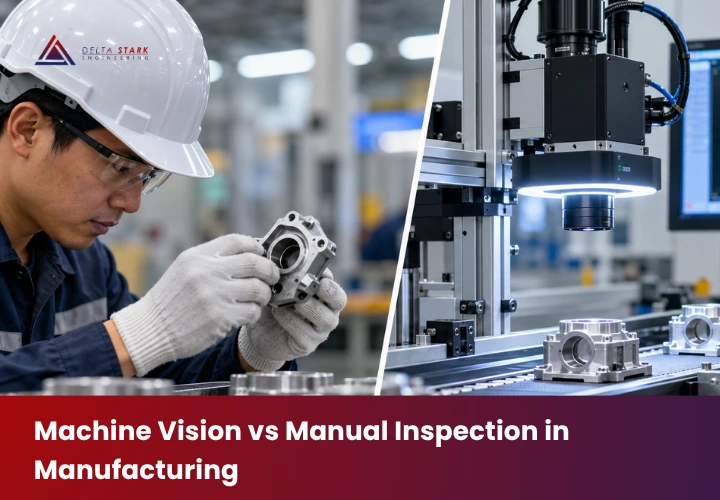
Manual inspection is a process in which trained workers examine products or components to check whether they meet quality requirements. Inspectors use their eyes and tools such as measuring instruments, magnifying glasses, and gauges to find defects.
This method is common in automotive, electronics, food, and metal manufacturing. Workers identify scratches, cracks, dents, and missing parts before products move forward.
A major advantage is human judgment. Experienced workers can notice unusual issues and make decisions based on their knowledge. They can also adapt when product designs or inspection requirements change.
However, high production volumes make manual inspection difficult. Fatigue and distractions can cause missed defects, inconsistent results, and delays.
What Is Machine Vision in Manufacturing?
Machine vision uses cameras, lighting, and software to inspect products automatically. The system captures an image and analyzes it to identify defects or check whether a product meets specific requirements.
In automotive factories, it can check dimensions and part positioning. In electronics, it can identify missing components and visible soldering defects.
Machine vision inspects products repeatedly and stores results for quality tracking. Advanced systems may use artificial intelligence, but performance depends on setup, image quality, and regular checks.
Key Differences Between Machine Vision and Manual Inspection
1. Speed and Productivity
Human inspectors need time to check each product, so examining thousands daily can create bottlenecks.
Machine vision inspects products quickly on continuous production lines. This is useful when items move along a conveyor and stopping production is costly. A properly designed system can check products as they pass, reducing delays and helping maintain productivity.
2. Accuracy and Consistency
Manual inspection depends on a worker’s experience, concentration, and working conditions. Even skilled inspectors may miss defects because of tiredness, distractions, or poor lighting.
Machine vision applies programmed rules or trained models consistently. When configured correctly, it can detect visual defects and separate acceptable products from defective ones.
Still, machine vision is not perfect. Poor lighting, reflective surfaces, camera positioning, or incorrect settings can affect results. Regular testing and maintenance help keep the system reliable.
3. Cost and Investment
Manual inspection costs less to start and suits small manufacturers or low-volume production.
Machine vision requires cameras, lighting, software, installation, and training. Although the initial cost is higher, it may reduce waste and quality failures. Its value depends on production volume and defect costs.
4. Flexibility and Adaptability
Human inspectors adapt quickly to unusual defects, making them useful for customized products and small batches.
Machine vision may need new settings when designs change, and these must be tested. Manual inspection suits frequent changes; machine vision suits repetitive tasks.
5. Data Collection and Record Keeping
Manual results are recorded on checklists or spreadsheets, which take time and may omit information.
Machine vision records results and saves defect images, helping teams spot recurring problems, track trends, and investigate customer complaints.
Benefits of Combining Both Inspection Methods
Manufacturers can combine both methods for a practical balance.
Machine vision can check dimensions, surface defects, labels, and component placement. People can focus on unusual problems requiring closer examination.
The roles should be clear: the system identifies possible issues, while workers investigate uncertain results and handle exceptions. Staff training remains important because employees need to understand the system’s alerts and know when an inspection needs a second look.
A vision system can flag possibly defective items for a worker to examine and approve, repair, or reject. This combines automation’s speed with human judgment and leaves employees more time to solve quality problems.
How to Choose the Right Inspection Method
Production volume is a useful starting point: machine vision suits high-volume lines, while manual checks may suit small batches.
Clearly defined visual defects and measurable dimensions suit machine vision. Problems requiring touch or interpretation may need people.
Before deciding, companies should test the method on actual products and compare results with current inspections. They should measure missed defects, false alarms, inspection time, and maintenance needs. These checks provide practical evidence and help teams choose technology based on results rather than assumptions.
Compare automation costs with savings from less waste and improved productivity. Consider lighting, product variation, maintenance, and integration. A pilot project can test performance before a larger investment.
Conclusion
Machine vision and manual inspection both play important roles in manufacturing quality control. Manual inspection offers flexibility, human judgment, and lower initial costs. Machine vision provides speed, consistent checks, and automated data collection.
The choice depends on production needs, budget, and product complexity. Combining methods is often effective: automation handles routine checks while people investigate unusual cases.
As manufacturing evolves, machine vision will remain valuable. Combining automation with human expertise can reduce defects, improve efficiency, and help deliver products that meet customer expectations.