
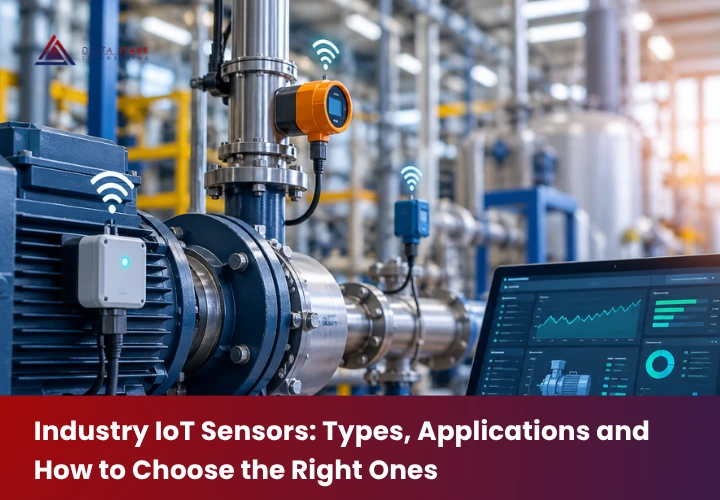
Introduction
Every plant has a machine that “always acts up right before a big order.” Maintenance teams know the feeling: you either fix things after they break or service them on a fixed schedule, whether they need it or not.
Industry IoT sensors offer a smarter path. They give your equipment a voice, so you hear about problems early instead of at 2 a.m. on a Sunday. In this guide, we’ll explain what these sensors are, the main types, where they’re used, and how to choose the right ones for your operation.
What Are Industry IoT Sensors?
Industry IoT sensors are connected devices that measure physical conditions, such as temperature, vibration, pressure, flow, or gas levels, on machines and processes. They send that data over a network to software that monitors equipment health, flags problems early, and supports faster decisions.
In short, they turn physical activity into data you can act on.
Why Industry IoT Sensors Matter
Unplanned downtime is costly in manufacturing, energy, logistics, and utilities. Industry IoT sensors help you catch faults before they become failures, reduce emergency repairs, improve worker safety, cut energy waste, and make decisions from evidence instead of guesswork. Instead of reacting to problems, your team starts planning around them.
Key Types of Industry IoT Sensors
There are dozens of sensor types, but most industrial projects start with these five.
Temperature sensors
track heat in motors, bearings, furnaces, and cold storage. Rising temperature is often the first sign of friction, overload, or a failing component.
Vibration sensors
learn a machine’s normal “signature.” When a bearing wears or a shaft goes out of alignment, the pattern changes. They are the backbone of predictive maintenance for pumps, fans, and compressors.
Pressure sensors
monitor hydraulic systems, pipelines, boilers, and tanks, helping you spot leaks, blockages, and unsafe operating conditions before they escalate.
Flow sensors
measure how much liquid or gas moves through a pipe. They are vital in water treatment, oil and gas, food processing, and pharmaceuticals, where consistency matters.
Key Applications of Industry IoT Sensors
Predictive maintenance
This is the most popular use case. By combining vibration, temperature, and current data, teams can predict failures and schedule repairs during planned downtime rather than mid-shift.
Quality control
Sensors watch conditions during production, so deviations are flagged before they turn into scrap or recalls.
Energy management
Power and environmental data show where energy is being wasted. Many plants find savings simply by seeing, for the first time, which equipment runs when it doesn’t need to.
Safety and compliance
Gas, heat, and pressure sensors can trigger alerts or automatic shutdowns when readings cross safe limits. They also create an audit trail for inspections.
Asset tracking
Location and condition sensors follow equipment and shipments through the supply chain, including temperature monitoring for cold-chain goods.
Remote monitoring
For pipelines, solar farms, and mining sites, sensors reduce trips to hard-to-reach locations just to check a gauge.
How to Choose the Right Industry IoT Sensors
The goal isn’t the fanciest sensor. It’s the right one. Ask yourself:
- What problem are we solving? Start with a specific pain point, like a pump that keeps failing.
- What’s the environment? Heat, dust, moisture, and explosive atmospheres all limit your options.
- How accurate must it be? Some jobs need precision, while others just need a dependable alert.
- How will it connect? Wired, Wi-Fi, Bluetooth, LoRaWAN, and cellular each suit different sites and power budgets.
- What about power and upkeep? Battery life and replacement effort matter more than people expect at scale.
Common Challenges and How to Handle Them
Data overload
Thousands of readings mean nothing without context. Set clear thresholds and use analytics that surface only what needs attention.
Security
Every connected device is a potential entry point. Use encryption, network segmentation, and regular firmware updates.
Legacy equipment
Older machines often lack digital outputs. Retrofit sensors can bring them online without replacing them.
Conclusion
Industry IoT sensors turn silent machines into reliable sources of insight. Whether your priority is cutting downtime, improving quality, saving energy, or keeping people safe, the right sensors give you the visibility to act sooner and with more confidence.
At Delta Stark, we help businesses select, deploy, and connect the right sensing technology for their operations. Not sure where to start? Talk to our team and we’ll help you find the first use case worth tackling.