
Introduction
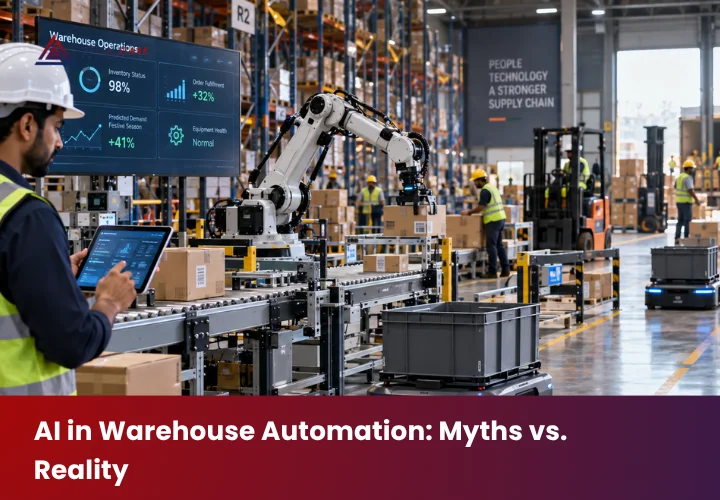
AI in warehouse automation can genuinely help Indian warehouses forecast demand around festive sales spikes, plan smarter picking routes, and catch equipment problems before they cause downtime. It won’t run the warehouse by itself, and it definitely won’t fix messy inventory data or a shortage of skilled operators. It needs clean data, a realistic timeline, and people who still make the final call.
Walk into any conversation about logistics in India right now, and AI in warehouse automation comes up fast. With e-commerce volumes climbing every festive season, quick-commerce dark stores popping up in every city, and the National Logistics Policy pushing operators to get more efficient, warehouses across the country are under real pressure to automate. But the stories floating around are all over the place. Some say AI will replace lakhs of warehouse jobs within a few years. Others say it’s mostly marketing dressed up as innovation, and it never survives contact with an actual Indian warehouse floor, given the power cuts and patchy data most facilities deal with.
Here’s what’s myth, what’s real, and what it actually looks like when Indian warehouses put AI in warehouse automation to work.
Myth 1: AI in Warehouse Automation Will Replace Warehouse Workers Across India
Reality: AI takes over tasks, not the workforce.
India’s warehousing sector employs a huge number of people, and that isn’t changing overnight. What AI does is take repetitive tasks, like walking the floor to pick items, manually counting stock, or sorting returns, off people’s plates. Someone still needs to handle the mismatched order, the AMR that’s stuck near a loading dock, or the returned batch that doesn’t scan properly.
In practice, roles shift rather than vanish. Pickers move into robot fleet supervision, exception handling, or data quality checks. Operators in cities like Bhiwandi, Gurugram, and Bengaluru who’ve invested in AI have found that reskilling existing staff works far better than assuming automation means fewer people on the payroll, especially when labour is still one of the more cost-effective parts of running a warehouse in India. On automation projects across the country, the facilities that plan for this shift from day one always have a smoother go-live.
Myth 2: AI Tools Work Perfectly From Day One
Reality: It takes time to learn your warehouse, not someone else’s.
Most AI demos run on clean, curated data. Indian warehouses, especially ones that have grown fast or absorbed multiple regional facilities, often have messier records: SKUs coded differently across locations, inconsistent inventory counts, and gaps from manual processes that only recently went digital. A forecasting tool trained on six months of inconsistent data will give unreliable predictions no matter how advanced it is.
This matters even more around events like Diwali or the Republic Day sale period, when demand swings hard and fast. Warehouses that get AI forecasting right usually spend the first festive cycle or two comparing the AI’s calls against what an experienced planner would say, before trusting it to run unsupervised. That’s why well-planned automation projects build in a calibration phase rather than switching everything on at once.
Myth 3: This Is Only for Large E-commerce Players
Reality: Mid-size 3PLs and regional warehouses can use it too.
You don’t need a massive enterprise budget to benefit from AI. Cloud-based WMS platforms built for the Indian market now come with AI features baked in, from demand forecasting to smart slotting to automated reorder points, priced for mid-size 3PLs and even D2C brands running their own fulfilment. A regional operator serving tier-2 and tier-3 cities can get real value from AI-driven slotting without ever buying a single robot.
This is especially relevant as quick-commerce and D2C brands push warehousing infrastructure into smaller cities where labour costs and real estate differ a lot from the major metros. AI tools that adjust to local demand patterns are often more useful there than expensive robotics, since a solution that works in a metro hub doesn’t always make sense for a smaller regional facility.
Myth 4: More AI Tools Automatically Mean Better Results
Reality: Disconnected systems create more problems than they solve.
It’s easy to end up with a forecasting tool from one vendor, a routing tool from another, and a labour scheduling tool from a third, none of them talking to each other. If the forecasting system flags a demand spike ahead of a big sale event but the scheduling tool never gets that signal, you’re short-staffed exactly when you can’t afford to be.
The gains come from integration, ideally with systems that connect cleanly with your existing WMS and ERP, not from the sheer number of AI tools you’ve bought. Integration is where many automation projects quietly fail, since a warehouse’s automation is only as good as how well its pieces talk to each other.
Myth 5: AI Can Fully Handle Safety and Quality Checks
Reality: Human eyes still catch what cameras miss.
Computer vision systems can flag damaged pallets or unsafe stacking, but Indian warehouses often deal with variable lighting, dust, and setups not originally designed with cameras in mind. Unusual angles or defect types the system hasn’t seen before can slip through. Pulling human spot-checks out of safety workflows entirely is a real risk, not a shortcut worth taking.
What AI in Warehouse Automation Actually Delivers for Indian Warehouses
Once you strip away the hype, here’s where AI in warehouse automation reliably helps:
- Demand forecasting: smoothing out the chaos of festive and sale-season spikes
- Pick-path and slotting optimisation: less walking, faster turnaround on high-volume days
- Predictive maintenance: catching a failing conveyor or forklift before it stalls a shift
- Labour scheduling: matching staffing to actual order volume instead of guesswork
- Quality control: catching mis-picks and damage faster than manual sampling
These gains build up over months, not days, and they depend heavily on clean data and how well your systems are connected, not on how much automation you’ve bought.
A Practical Approach to AI in Warehouse Automation
Warehouses getting real value from AI in warehouse automation treat it as part of a larger automation strategy, not a standalone fix. A sound approach typically includes:
- Assessing the facility first: layout, existing WMS/ERP setup, and data quality, before recommending any AI tool
- Designing for integration: making sure forecasting, routing, and scheduling systems actually share data instead of working in silos
- Phased rollouts: starting with a calibration period so the AI learns your warehouse’s real patterns before it’s trusted with bigger decisions
- Keeping people in the loop: building workflows where human oversight stays in place for safety checks and edge cases
- Regional fit: recommending automation levels that make sense for the facility’s size and location, whether that’s a metro fulfilment hub or a tier-2 city warehouse
Questions to Ask Before You Invest
Before signing on with an AI vendor, a few honest questions go a long way:
- How much historical data does this need before its predictions are actually reliable?
- How does it handle situations it’s never seen before, like a sudden regional demand spike?
- Does it integrate with our existing WMS and ERP, or do we have to rebuild from scratch?
- What’s a realistic timeline to see returns, given our order volumes?
- How much ongoing human oversight does this actually need?
If a vendor can’t answer these clearly, or promises instant, hands-off automation, that’s worth questioning further.
Frequently Asked Questions
Will AI replace warehouse jobs in India?
Not entirely. AI automates specific repetitive tasks like picking routes and forecasting, but Indian warehouses still need people for exception handling, oversight, and managing the systems themselves.
How long does it take to see ROI from AI in warehouse automation in India?
Most operators see measurable results within one or two festive sale cycles, roughly 4 to 8 months, assuming the underlying data is clean and the rollout is well scoped.
Is AI in warehouse automation only for large e-commerce companies?
No. Cloud-based, subscription-priced AI tools are increasingly built for mid-size 3PLs, D2C brands, and regional warehouses serving tier-2 and tier-3 cities.
What causes most AI in warehouse automation projects in India to underdeliver?
Usually it’s inconsistent inventory data, unrealistic timelines, or disconnected systems, not the AI technology itself.
Conclusion
AI in warehouse automation won’t single-handedly transform Indian logistics overnight, and it isn’t hype either. It’s a practical set of tools that genuinely help with forecasting festive demand, planning smarter picking routes, and catching problems before they cause downtime, provided the data is clean, the systems are connected, and the expectations are realistic. The Indian warehouses getting real value from AI in warehouse automation right now aren’t the ones with the flashiest robots. They’re the ones that matched the right tool to the right problem and kept experienced people in the loop where judgment still counts.
At Delta Stark Engineering, that’s exactly how we approach every automation project: practical, phased, and built around what actually works on your warehouse floor.