
Introduction
From the moment a product is manufactured to the time it is dispatched, automation is slowly changing how manufacturers handle their products. Handwritten data is becoming difficult to maintain as factories scale and customers demand greater accuracy and speed.
In this blog, we explore what warehouse automation is, its significance for manufacturers, and how it is changing the production-to-dispatch process.
What Is Warehouse Automation in Manufacturing?
Automation is the use of technology, including robotics, automation systems, sensors, and software, to perform warehouse operations with little to no human involvement. It replaces manual, repetitive processes with automated processes to move, sort and track goods more efficiently.
In factories, automation typically covers tasks that would otherwise be done manually, such as handling materials, stocking, order picking, packing, and inventory tracking, which rely heavily on manual labour and are susceptible to human error.
Why Warehouse Automation is Important for Manufacturers
Today, manufacturers face continuous pressure to reduce product turnaround times while maintaining accuracy and consistency across high stock volumes. To cater to such demands, manufacturers can rely on warehouse logistics automation that streamlines the movement of goods within the warehouse, reduces dependence on manual labour, and minimises human error.
It also enables companies to expand their operations without hiring additional staff, which can be particularly helpful during peak demand or seasonal changes.
The Production-to-Dispatch Workflow
To understand the value of automation, it is important to see how it integrates into the overall manufacturing process.
This is how the usual production-to-dispatch journey proceeds after automation:
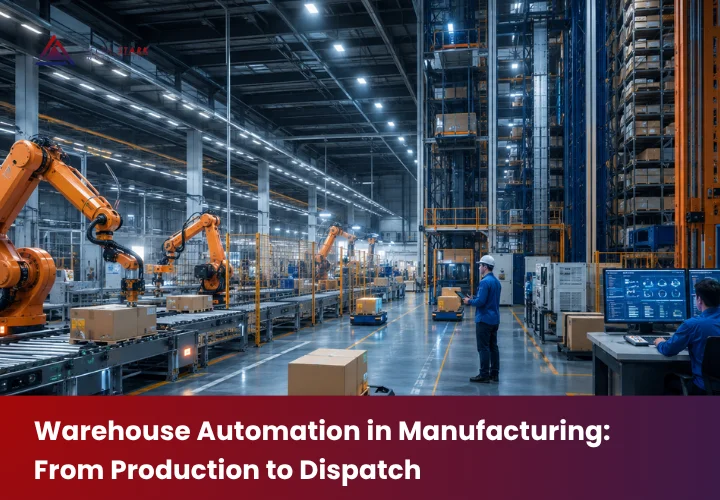
- Automated conveyors or guided vehicles move the finished product from the production line to storage.
- Stock management systems automatically update stock levels and locations in real time as goods move through the warehouse.
- The automated picking system uses digital instructions to guide the picking machine to select the correct items for an order, thereby minimising manual sorting.
- Automated packing stations pack, label and prepare products for onward transport.
- The dispatch systems work in coordination with logistics software, and they both are used to manage shipping schedules and load shipments efficiently.
Each of these stages works together to create a connected, end-to-end flow, rather than a series of disjointed manual handovers.
Benefits of Warehouse Automation in Manufacturing
Here are some of the advantages of factory warehouse automation that manufacturers can look forward to:
- Fewer manual labour hours are needed to perform repetitive tasks, reducing operational costs.
- Orders are much less likely to be picked or labelled incorrectly by an automated system than by hand.
- Often, automated storage systems are designed to be as efficient as possible in using vertical and horizontal warehouse space.
- Improved dispatch speed and timely delivery meet customer expectations and manufacturers’ delivery requirements.
- Improved worker safety due to automation of tasks, as they might otherwise be risky for workers.
Combined, these advantages create a more productive and efficient industrial enterprise where large quantities of stock are involved.
Future of Warehouse Automation in Manufacturing
With ongoing technological development, the scope of automation will expand significantly.
AI and machine learning are gaining traction in warehouses and becoming more integral to warehouse solutions, helping manufacturers predict stock needs before they arise.
The emergence of autonomous mobile robots is also increasing, providing much more flexibility than rigid conveyor systems in warehouses that must adapt quickly to changing layouts and order volumes.
Moreover, with the increasing prevalence of Internet of Things (IoT) sensors, manufacturers can now obtain real-time information of the entire warehouse environment, from raw materials to final dispatch.
As these technologies evolve, automation will increasingly rely on the development of a fully integrated, intelligent warehouse ecosystem rather than on isolated technologies.
Conclusion
Warehouse automation is no longer only for large-scale manufacturers. It is a requirement for all businesses which want to stay relevant in a very dynamic and demanding market.
By upgrading to logistics automation, companies are now able to improve the flow from production to dispatch, which in turn reduces errors, decreases costs and in the end gives the customer a better experience, which they wait for at the end of the supply chain.