
Introduction
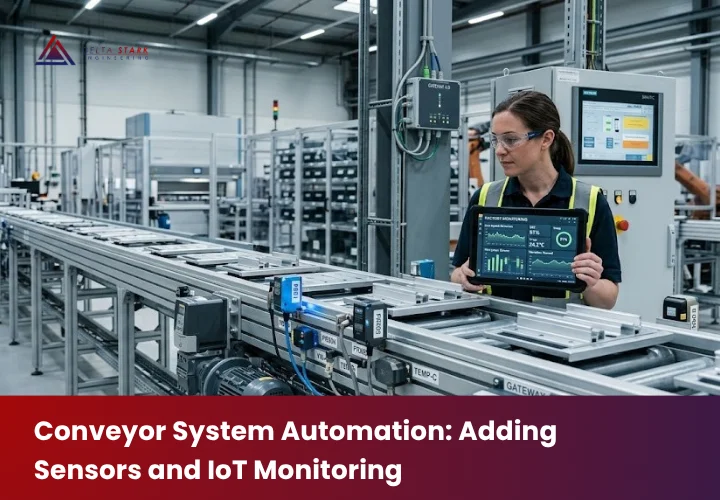
Manufacturing facilities are becoming more connected, and conveyor systems are evolving with them. Traditionally, conveyors were mainly used to move materials, components, and finished products between production stages. Today, conveyor system automation can combine sensors, PLCs, industrial controls, and IoT monitoring to make material handling more efficient and easier to monitor.
For manufacturers, this technology can provide better visibility into conveyor performance, support maintenance planning, reduce manual intervention, and improve production flow.
What Is Conveyor System Automation?
Conveyor system automation uses automated controls and equipment to manage material movement with limited manual intervention. Depending on the application, an automated conveyor may include motors, variable frequency drives (VFDs), programmable logic controllers (PLCs), sensors, safety devices, and human-machine interfaces (HMIs).
An automated conveyor can control product movement, speed, positioning, accumulation, and start-stop sequences. It can also communicate with other machines in a production line.
For example, a conveyor transporting components to an assembly station can automatically stop when the workstation is occupied and restart when the next production cycle is ready.
Why Are Sensors Important in Conveyor Automation?
Sensors allow an automated conveyor system to understand what is happening on the production line. They can detect products, monitor equipment conditions, and provide information to the control system.
Photoelectric sensors can detect products without physical contact and are useful for counting, positioning, and product detection.
Proximity sensors can detect objects within a specified range and are commonly used for position monitoring and automated sequencing.
Temperature sensors can monitor motors, bearings, and other components. An unexpected temperature increase may indicate excessive load, friction, or developing equipment problems.
Vibration sensors can monitor rotating components. Changes in vibration patterns may indicate potential issues such as bearing wear, imbalance, or misalignment.
Speed sensors can verify conveyor speed and help identify conditions such as belt slippage or drive-related problems.
The right combination of sensors depends on the conveyor design, production process, operating environment, and equipment being monitored.
How IoT Monitoring Works With Conveyors
IoT monitoring connects physical conveyor equipment with digital monitoring systems. Sensors collect operating information, while PLCs, industrial gateways, or edge devices can process and transmit the data.
The information can then be displayed through a monitoring dashboard or connected to other factory systems.
For example, if a conveyor motor normally operates within a specific temperature and vibration range but its readings gradually increase, the monitoring system can generate an alert. Maintenance personnel can then inspect the equipment before the issue develops into a major failure.
This approach can help manufacturers move from reactive maintenance toward more data-supported maintenance planning.
Benefits of Sensor Based Conveyor Automation
Reduced Unplanned Downtime
A conveyor breakdown can affect several connected production processes. Monitoring critical equipment can help identify abnormal conditions before they result in unexpected stoppages.
Better Maintenance Planning
Real-time equipment information can support condition-based maintenance. Maintenance teams can use operating trends along with physical inspections and manufacturer recommendations to plan servicing more effectively.
Faster Troubleshooting
When an automated conveyor develops a fault, sensor information and system alerts can help technicians identify the affected area more quickly, potentially reducing troubleshooting time.
Improved Production Visibility
IoT-enabled conveyor systems can provide information about equipment status, product movement, stoppages, and other operating conditions. This can help production teams identify recurring bottlenecks.
Better Material Flow
Sensors can help control product spacing, positioning, and accumulation. This can improve coordination between production stations and reduce unnecessary manual handling.
Connecting Conveyors With Factory Automation
Conveyors rarely operate alone in modern manufacturing. They may be connected with robotic systems, assembly equipment, inspection machines, packaging systems, and other automated processes.
For instance, a conveyor supplying components to a robotic workstation can use sensors to confirm product position before the robot begins its operation. The conveyor and robot can then work according to a defined production sequence.
This type of integration can improve coordination between machines and create a smoother material-handling process.
What Should Manufacturers Consider?
Before adding sensors and IoT monitoring, manufacturers should identify the equipment and operating conditions that have the greatest effect on production.
Important considerations include:
- Which conveyor components are critical?
- What failures occur frequently?
- Which parameters should be monitored?
- Where should sensors be installed?
- Can the existing PLC support integration?
- How will equipment data be communicated?
- Which conditions should trigger alerts?
- Can the system be expanded in the future?
A phased approach can be practical. Manufacturers can begin by monitoring critical motors, bearings, drives, or conveyor sections and gradually expand monitoring based on operational requirements.
Choosing the Right Conveyor Automation Solution
Every manufacturing facility has different requirements. Conveyor length, product dimensions, load capacity, operating speed, available space, environmental conditions, and integration requirements can all influence system design.
Therefore, conveyor automation should be developed around the actual production application rather than relying on a standard configuration.
Delta Stark Engineering provides industrial automation and factory equipment solutions, including conveyor systems designed for different manufacturing applications. Its solutions can be customized according to production requirements and integrated with broader factory automation processes.
Working with an experienced automation solution provider can help manufacturers select suitable sensors, controls, conveyor configurations, and monitoring technologies for their specific needs.
Conclusion
Conveyor system automation with sensors and IoT monitoring can help manufacturers build more connected, efficient, and reliable material-handling operations. Sensors provide real-time information about products and equipment, while PLCs and automation controls manage conveyor movement and coordination with other machines.
As manufacturers continue adopting Industry 4.0 technologies, smart conveyor automation can become an important part of modern factory operations. With customized conveyor and industrial automation solutions, Delta Stark Engineering can help manufacturers move toward more connected and efficient production systems.