
Introduction
Robots play a pivotal role in warehouse management and material handling solutions. They not only perform heavy, repetitive tasks efficiently but also reduce long-term costs. In addition, they are scalable, lessen the chances of errors, and provide real-time inventory tracking. Let’s delve into how these versatile machines can take your business to greater heights.
What Is Warehouse Automation?
Warehouse automation is the process of using technology to move, store, and manage inventory with minimal human effort. It replaces slow manual processes with smart, connected systems.
There are two main types. Digital automation uses software to eliminate manual data entry and manual processes like cycle counting and reporting. Physical automation uses machines — robots, conveyors, and autonomous vehicles to handle goods directly on the warehouse floor.
Together, they form a complete warehouse automation strategy. Most modern facilities combine both, supported by a warehouse management system (WMS) that coordinates every task across the supply chain from the moment goods arrive to the moment orders ship.
Businesses adopt warehouse automation to increase productivity, reduce errors, improve worker safety, and stay competitive as order volumes grow.
Challenges in Traditional Warehouse Operations
Various operational challenges faced by traditional warehouse operations include:
- Poor inventory management:
A lack of staff, undertrained staff, processing delays, mistakes during picking and packing, etc. - Not adapting to seasonal demand:
Failing to meet the increasing market demand affects productivity and operations. - Inventory mismatch:
When inventory records don’t match the warehouse’s capacity, it can lead to financial losses and operational disruptions. - Poor space utilisation:
Optimal warehouse space utilisation is crucial to maximise storage capacity and order fulfilment.
Role of Material Handling Robots in Warehouses
Apart from boosting productivity and profitability, robots are an excellent modern solution for handling repetitive, physically demanding tasks. Their role includes, but is not limited to:
- From heavy pallets to finished goods, robots assist in transporting goods across the warehouse.
- Robots can classify elements in a specific order or pattern and sort items for shipping with no margin for error.
- They are capable of handling toxic, polluting, or hazardous materials that pose a danger to humans.
- Equipped with predictive capabilities, these automated machines can manage inventory efficiently, ensuring a smooth flow of orders.
Learn more about Material Handling Robots
Types of Robots Used in Warehouse Automation
Specialised robots that are designed for warehouse automation include:
Conveyor Robots
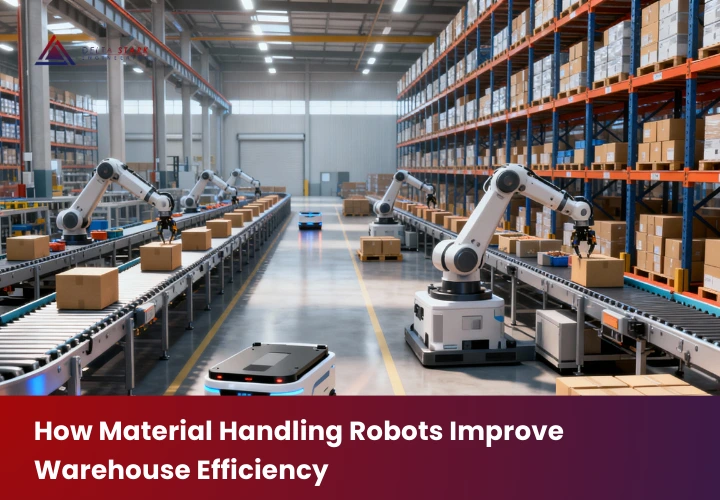
These automated systems combine robotic arms or Autonomous Mobile Robots (AMR) to manage warehouse operations. They utilize advanced technologies like machine learning and artificial intelligence to automate warehouse tasks.
- Optimise the manufacturing process.
- Enables high-volume packaging.
- Improves logistics and distribution.
- Offers integrated controls with better flexibility.
Pick & Place Robots
As the name suggests, these robots pick goods from one part of the warehouse and keep them in another. They utilise a combination of sensors and robotic arms to navigate smoothly, freeing up human workers for their following roles. These robots find application in manufacturing, logistics, and packaging.
- Quickly sort products according to size, weight, etc.
- Can detect defective products, thus improving quality control.
- Organise products for packaging and shipping.
Learn more about Pick and Place Robots
Autonomous Mobile Robots (AMRs)
Autonomous mobile robots (AMRs) are self-navigating robots that move through the warehouse without fixed tracks or guides. They use sensors, cameras, and artificial intelligence (AI) to map the warehouse floor and find the fastest route in real time.
AMRs are ideal for order picking, replenishment, and transporting goods between zones. They can operate alongside human workers safely and adapt to changes in the existing warehouse layout without reprogramming.
Unlike older automated guided vehicles that need magnetic tape or wires on the floor, autonomous mobile robots (AMRs) are flexible. You can deploy them quickly, and scale the fleet up or down as demand changes.
Automated Storage and Retrieval Systems (AS/RS)
Automated storage and retrieval systems (AS/RS) — also called storage and retrieval systems — automatically move goods into storage and retrieve them on demand. They include vertical lift modules, unit-load cranes, tote shuttles, and mini-loaders.
These retrieval systems (RS) dramatically increase productivity by reducing the time workers spend searching for items. They also maximise vertical space in the existing warehouse, which is critical when floor space is limited.
AS/RS units connect directly to the WMS, so every put-away and retrieval is tracked in real time. This keeps inventory records accurate and supports fast, error-free order picking.
Types of Warehouse Automation Technology
Understanding the types of warehouse automation technology helps businesses choose the right solution for their needs. Here is a clear overview:
Conveyor Systems — Transport goods between zones. High throughput with low labour dependency.
Autonomous Mobile Robots (AMRs) — Flexible picking and transport across the warehouse. No fixed paths required, easy to scale up or down.
Automated Storage and Retrieval Systems (AS/RS) — Dense storage and fast retrieval. Maximises vertical space in the existing warehouse.
Pick-to-Light Systems — Guide workers to exact pick locations using LED displays. Reduces mispicks and speeds up order fulfillment.
Voice Picking — Hands-free order fulfillment using headsets and voice commands. Improves both speed and improved safety on the warehouse floor.
Automated Sortation — High-speed sorting and routing of goods on conveyors. Reduces manual sorting errors significantly.
Warehouse Management System (WMS) — Coordinates all warehouse processes from a single platform. Provides real-time visibility and control across every operation.
Each technology addresses specific gaps in warehouse processes. Many operations combine several of them for maximum efficiency. A WMS acts as the central controller, integrating all systems into a unified workflow.
Key Benefits of Robots for Warehouse Efficiency
Every business owner can enhance their efficiency and productivity with robots. Here is how:
Speed and Accuracy
Robots follow the fastest route in the warehouse while transporting goods, thereby enhancing productivity and optimising space utilisation. Their streamlined, automated processes guarantee 100% accuracy and reduce delivery delays.
Reduced Labor Costs
The robot’s higher efficiency brings down labor costs. This, in turn, lowers warehouse inventory costs, benefiting the owner.
Minimised Errors
Warehouse automation robots minimize the gap for errors to almost zero, enabling scalability, customer satisfaction, and safety. They also successfully carry out risky tasks that may otherwise result in labour injuries or require a high-skilled workforce.
Improved Safety
Improved safety is one of the most significant advantages of warehouse automation. Robots handle heavy lifting, hazardous material transport, and high-repetition tasks that commonly cause worker injuries.
When robots take over these roles, human workers face fewer physical risks. This leads to lower incident rates, reduced workers’ compensation costs, and a healthier working environment overall. Improved safety also supports regulatory compliance and helps businesses retain staff.
Safety and Compliance Considerations
The robots are manufactured in accordance with specific robotic standards, such as ISO 13482 and ISO/TS 15066. Complying with such standards safeguards warehouse operations and ensures worker safety.
Integration with Warehouse Management Systems (WMS)
Warehouse Management Systems, or WMS, act as a controller for the robotic warehouse system.They enable seamless communication between robots and ensure consistency and accuracy in material-handling solutions. This innovative software solution allows task coordination and inventory management by reducing mistakes and improving warehouse safety.
A warehouse management system (WMS) does far more than track stock levels. When integrated with automation hardware, it directs autonomous mobile robots (AMRs) to the right pick locations, coordinates automated storage and retrieval operations in real time, and assigns order picking tasks based on priority and proximity. It also flags equipment that needs ongoing maintenance before a breakdown occurs. This level of coordination reduces costly errors, shortens order cycle times, and gives supply chain managers live visibility across all warehouse processes.
Artificial Intelligence and Machine Learning in Warehouse Automation
Artificial intelligence (AI) and machine learning (ML) are now core to how modern warehouses operate. These technologies make automation smarter over time.
Artificial intelligence and machine learning power several critical functions:
- Demand forecasting — predicting which products need replenishment before stock runs out
- Route optimisation — calculating the fastest path for autonomous mobile robots (AMRs) across the warehouse floor
- Anomaly detection — identifying unusual patterns in inventory data that could signal errors or theft
- Predictive maintenance — alerting operations teams when equipment is likely to fail, reducing unplanned downtime
Machine learning (ML) improves with every warehouse operation it processes. The more data it collects, the more accurately it can forecast demand, improve order picking speed, and optimise storage and retrieval systems. Businesses that adopt AI-powered automation now will find it increasingly difficult for competitors relying on manual processes to keep pace.
Warehouse Automation and the Supply Chain
Warehouse automation does not exist in isolation. It is a critical part of the wider supply chain.When warehouses run efficiently, every part of the supply chain benefits. Suppliers receive more accurate replenishment orders. Carriers face fewer last-minute changes. Customers receive their goods faster and with fewer errors.
Automation gives supply chain managers real-time data on inventory levels, order status, and warehouse throughput. This visibility allows them to make faster decisions and respond to disruptions — such as sudden demand spikes or supplier delays — without manual escalation.
Businesses with automated warehouses are better positioned to handle peak seasons, new product launches, and rapid growth without hiring large numbers of temporary staff. Automation provides the flexibility the supply chain needs to stay resilient.
Ongoing Maintenance of Warehouse Automation Systems
Every automated system requires ongoing maintenance to perform reliably. Robots, conveyors, AS/RS units, and WMS software all need regular servicing.
Best practices for ongoing maintenance include:
- Using WMS data and sensor alerts to schedule preventive maintenance before failures occur
- Conducting routine inspections of mechanical components such as belts, motors, and wheels
- Keeping firmware and software updated to maintain compatibility between systems
- Training in-house technicians or partnering with the equipment provider for specialist support
- Maintaining a spare parts inventory for high-wear components to reduce repair downtime
Proactive ongoing maintenance extends the lifespan of automation equipment, protects ROI, and prevents costly unplanned downtime. Businesses should factor maintenance costs into their automation budget from day one.
Delta Stark’s Warehouse Robot Solutions
Delta Stark’s robotic engineering encompasses the best engineering practices and detailed planning to maximise warehouse output. Our pick-and-place and conveyor robots are not just an upgrade but a necessity for businesses. We evaluate your current operations and propose the best-fit warehouse automation robots for your business. Business owners can also opt for our scalable robotic solutions, which can easily adapt to accommodate their inventory orders as order volume increases.
Why Businesses are Adopting Warehouse Automation and Robotics
Companies are finding more ways to automate their warehouses and use robotics in order to meet the increasing demands and expectations of their customers. Robotics and automation of warehouses can help make everyday business operations smoother by minimizing mistakes, maximizing efficiency, and organizing inventory. It also cuts costs, improves workplace safety, and gives companies the flexibility to handle busy seasons or sudden spikes in demand. By adopting robotics, businesses can streamline their supply chains, maintain consistent performance, and stay ahead in today’s fast paced market.
Conclusion
Robots are the cornerstone of manufacturing and warehousing. Their incorporation in warehousing boosts productivity, lowers costs, and offers a safer working environment. Embrace precise integration and advanced engineering with Delta Stark’s warehouse robotic solutions. Multiply your warehouse productivity with robots and stay competitive and efficient in your supply chain operations.
FAQ (Frequently Asked Questions)
1. How do material handling robots improve warehouse efficiency?
They speed up picking, sorting, and moving goods while reducing errors for smoother warehouse operations.
2. What types of robots are used in warehouse automation?
Conveyor robots and pick-and-place robots are commonly used to move, sort, and handle products automatically.
3. Do material handling robots reduce labor costs?
Yes. Robots take over repetitive and heavy tasks, cutting labor expenses and improving overall productivity.
4. How do robots integrate with Warehouse Management Systems (WMS)?
Robots sync with WMS to receive tasks, update inventory in real time, and ensure accurate and coordinated operations.
5. What is the difference between AMRs and AGVs?
Autonomous mobile robots (AMRs) navigate independently using AI and sensors, adapting to changes in the warehouse layout. Automated guided vehicles (AGVs) follow fixed pre-set paths and require more infrastructure. AMRs are more flexible and faster to deploy in an existing warehouse.
6. How does warehouse automation improve supply chain performance?
Automation speeds up order fulfilment and reduces errors, which means fewer delays in the supply chain. Real-time WMS data also gives supply chain managers visibility across inventory levels and order status, allowing faster and more accurate decisions.