
Introduction
Robotics has moved well beyond the factory-floor stereotype, but for most businesses, the real value still starts there. Manufacturing, logistics, healthcare, and agriculture all lean on robots to cut costs, reduce errors, and handle work that’s repetitive, dangerous, or too precise for the human hand. If you’re evaluating automation for your operation, here’s a practical breakdown of the major robot types and the industries using them.
What Is a Robot, Really?
At its core, a robot is a programmable machine that senses its environment, processes that information, and takes physical action, usually without a person directing every move. That could be a six-axis arm welding car frames on an assembly line, or a drone mapping a farmer’s field from above. Different industries, different shapes, same basic loop: sense, think, act.
1. Industrial Robots (Manufacturing)
These remain the largest category of robots deployed worldwide.
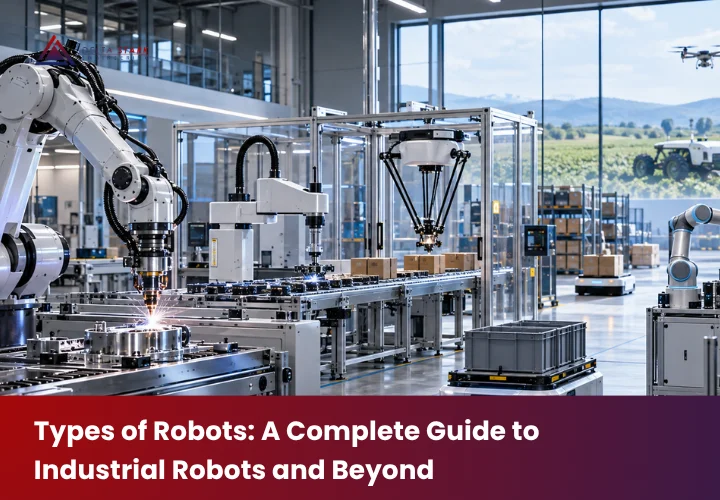
- Articulated robots: Mechanical arms with rotary joints, used heavily in automotive and electronics manufacturing.
- SCARA robots: Built for speed, common in electronics manufacturing for fast pick-and-place work.
- Cartesian robots: Also called gantry robots, common in heavy industry where accuracy on large parts matters most.
- Delta robots: Spider-like machines used in food and pharmaceutical packaging, where speed and hygiene both matter.
Quick answer: The articulated arm remains the most widely deployed industrial robot, largely because it adapts to the widest range of tasks with minimal retooling.
2. Collaborative Robots (Cobots) for Smaller Manufacturers
Cobots have become the entry point into automation for small and mid-size manufacturers that can’t justify a fully caged robotic line. Built-in force sensors let them work directly alongside employees without the safety barriers traditional industrial robots require, offering a faster return on investment without needing a dedicated robotics engineer on staff.
3. Mobile Robots (Logistics and Warehousing)
This category has exploded alongside e-commerce and supply chain growth.
- AGVs (Automated Guided Vehicles): Follow a fixed path, common in warehouses for repetitive material transport.
- AMRs (Autonomous Mobile Robots): Navigate dynamically using onboard sensors, increasingly standard in fulfilment centres with variable layouts.
- Drones (UAVs): Used across construction, agriculture, and logistics for inspection and last-mile delivery.
Quick answer: AGVs suit warehouses with stable layouts, while AMRs fit facilities with frequent layout changes or variable order volume.
4. Service and Consumer Robots (Retail and Hospitality)
Retail and hospitality robots greet customers, deliver food, or manage inventory in stores, restaurants, and hotels. Beyond these industries, domestic robots like vacuums and lawn mowers make up a smaller but growing consumer market, while companion robots are increasingly used in education and elder care.
5. Agricultural Robots (Farming and AgTech)
Agriculture is one of the fastest-growing sectors for robotic adoption. These machines handle planting, weeding, harvesting, and crop monitoring with precision that reduces both labor costs and chemical use, addressing labor shortages that have hit farming particularly hard.
Matching Robot Types to Industry Needs
Choosing the right robot type depends on your industry’s specific demands. High-speed assembly is best served by articulated or delta robots. Businesses that need humans and robots to share space should look at cobots. Warehousing benefits most from AMRs, while healthcare needs dedicated surgical systems. Field inspection and delivery, common in construction and agriculture, typically call for drones, and retail or hospitality businesses often start automating with service robots.
Frequently Asked Questions
1. What industries use robots the most?
Manufacturing remains the largest adopter, followed by logistics, automotive, healthcare, and agriculture.
2. What is the most common type of industrial robot?
The articulated robotic arm, thanks to its flexibility across welding, assembly, and material handling.
3. Are cobots a good fit for small manufacturers?
Yes. They offer automation without the cost and space demands of a fully caged robot line, making them a common entry point for smaller manufacturers.
4. What’s the difference between a robot and an AI system?
A robot is the physical machine. AI is the software that may power its decision-making. Many industrial robots run on simple programmed logic rather than advanced AI, while plenty of AI systems have no physical robot attached at all.
Conclusion
Robotics isn’t a single technology businesses adopt once and move on from. It’s an expanding toolkit, with different robot types built for the specific demands of manufacturing, logistics, healthcare, and agriculture. Understanding these categories makes it easier to match the right automation to the right industry problem, and points to where robotics is headed next: deeper supply chain integration, closer collaboration with human workers, and a growing role in solving labour shortages across nearly every sector.