
Introduction
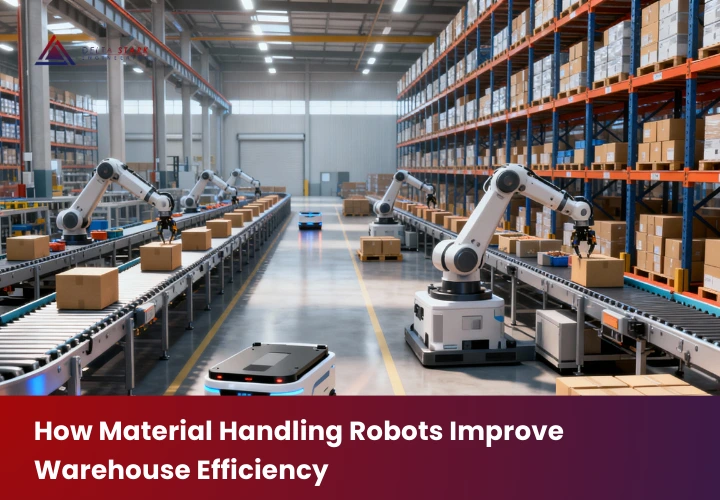
Robots play a pivotal role in warehouse management and material handling solutions. They not only perform heavy, repetitive tasks efficiently but also reduce long-term costs. In addition, they are scalable, lessen the chances of errors, and provide real-time inventory tracking. Let’s delve into how these versatile machines can take your business to greater heights.
Challenges in Traditional Warehouse Operations
Various operational challenges faced by traditional warehouse operations include:
- Poor inventory management: a lack of staff, undertrained staff, processing delays, mistakes during picking and packing, etc.
- Not adapting to seasonal demand: Failing to meet the increasing market demand affects productivity and operations.
- Inventory mismatch: When inventory records don’t match the warehouse’s capacity, it can lead to financial losses and operational disruptions.
- Poor space utilisation: Optimal warehouse space utilisation is crucial to maximise storage capacity and order fulfilment.
Role of Material Handling Robots in Warehouses
Apart from boosting productivity and profitability, robots are an excellent modern solution for handling repetitive, physically demanding tasks. Their role includes, but is not limited to:
- From heavy pallets to finished goods, robots assist in transporting goods across the warehouse.
- Robots can classify elements in a specific order or pattern and sort items for shipping with no margin for error.
- They are capable of handling toxic, polluting, or hazardous materials that pose a danger to humans.
- Equipped with predictive capabilities, these automated machines can manage inventory efficiently, ensuring a smooth flow of orders.
Learn more about Material Handling Robots
Types of Robots Used in Warehouse Automation
Specialised robots that are designed for warehouse automation include:
Conveyor Robots
These automated systems combine robotic arms or Autonomous Mobile Robots (AMR) to manage warehouse operations. They utilize advanced technologies like machine learning and artificial intelligence to automate warehouse tasks.
- Optimise the manufacturing process.
- Enables high-volume packaging.
- Improves logistics and distribution.
- Offers integrated controls with better flexibility.
Pick & Place Robots
As the name suggests, these robots pick goods from one part of the warehouse and keep them in another. They utilise a combination of sensors and robotic arms to navigate smoothly, freeing up human workers for their following roles. These robots find application in manufacturing, logistics, and packaging.
- Quickly sort products according to size, weight, etc.
- Can detect defective products, thus improving quality control.
- Organise products for packaging and shipping.
Learn more about Pick and Place Robots
Key Benefits of Robots for Warehouse Efficiency
Every business owner can enhance their efficiency and productivity with robots. Here is how:
Speed and Accuracy
Robots follow the fastest route in the warehouse while transporting goods, thereby enhancing productivity and optimising space utilisation. Their streamlined, automated processes guarantee 100% accuracy and reduce delivery delays.
Reduced Labor Costs
The robot’s higher efficiency brings down labor costs. This, in turn, lowers warehouse inventory costs, benefiting the owner.
Minimised Errors
Warehouse automation robots minimize the gap for errors to almost zero, enabling scalability, customer satisfaction, and safety. They also successfully carry out risky tasks that may otherwise result in labour injuries or require a high-skilled workforce.
Safety and Compliance Considerations
The robots are manufactured in accordance with specific robotic standards, such as ISO 13482 and ISO/TS 15066. Complying with such standards safeguards warehouse operations and ensures worker safety.
Integration with Warehouse Management Systems (WMS)
Warehouse Management Systems, or WMS, act as a controller for the robotic warehouse system.
They enable seamless communication between robots and ensure consistency and accuracy in material-handling solutions. This innovative software solution allows task coordination and inventory management by reducing mistakes and improving warehouse safety.
Delta Stark’s Warehouse Robot Solutions
Delta Stark’s robotic engineering encompasses the best engineering practices and detailed planning to maximise warehouse output. Our pick-and-place and conveyor robots are not just an upgrade but a necessity for businesses. We evaluate your current operations and propose the best-fit warehouse automation robots for your business. Business owners can also opt for our scalable robotic solutions, which can easily adapt to accommodate their inventory orders as order volume increases.
Why Businesses are Adopting Warehouse Automation and Robotics
Companies are finding more ways to automate their warehouses and use robotics in order to meet the increasing demands and expectations of their customers. Robotics and automation of warehouses can help make everyday business operations smoother by minimizing mistakes, maximizing efficiency, and organizing inventory. It also cuts costs, improves workplace safety, and gives companies the flexibility to handle busy seasons or sudden spikes in demand. By adopting robotics, businesses can streamline their supply chains, maintain consistent performance, and stay ahead in today’s fast paced market.
Conclusion
Robots are the cornerstone of manufacturing and warehousing. Their incorporation in warehousing boosts productivity, lowers costs, and offers a safer working environment. Embrace precise integration and advanced engineering with Delta Stark’s warehouse robotic solutions. Multiply your warehouse productivity with robots and stay competitive and efficient in your supply chain operations.
FAQ (Frequently Asked Questions)
1. How do material handling robots improve warehouse efficiency?
They speed up picking, sorting, and moving goods while reducing errors for smoother warehouse operations.
2. What types of robots are used in warehouse automation?
Conveyor robots and pick-and-place robots are commonly used to move, sort, and handle products automatically.
3. Do material handling robots reduce labor costs?
Yes. Robots take over repetitive and heavy tasks, cutting labor expenses and improving overall productivity.
4. How do robots integrate with Warehouse Management Systems (WMS)?
Robots sync with WMS to receive tasks, update inventory in real time, and ensure accurate and coordinated operations.