Introduction
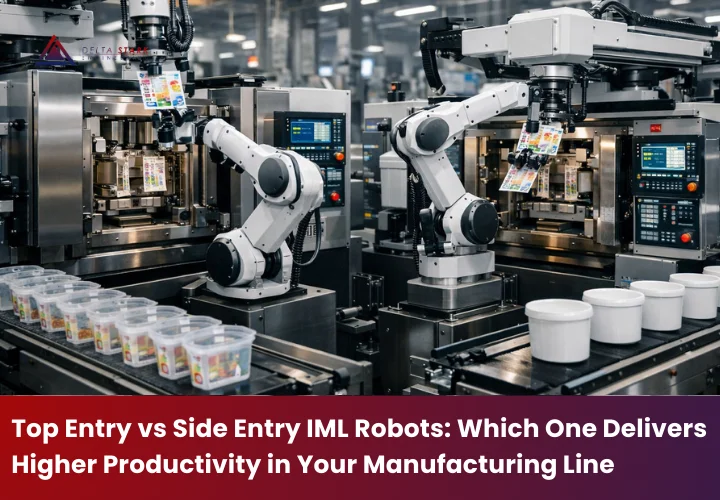
Modern production is becoming more automated, more precise, and quicker. In injection moulding processes where efficiency and consistency are essential to profitability, in-mould labelling technology offers a powerful solution. Injection molding robots are automated to place labels and increase the quality of goods, minimise manual operations, and improve overall line productivity.
This blog discusses IML robots and their functions, and compares the best entry robots and side entry robot systems.
What Are IML Robots?
IML is an abbreviation of In-Mould Labelling, a method in which pre-printed labels are positioned inside the mould, and then molten plastic is injected. After the moulding cycle finishes, the label becomes an important part of the final product, helping make the decoration durable and high-quality and preventing it from peeling or fading.
All this is automated by injection moulding robots used for IML. These robots pick labels from a magazine and stick them in the correct place within the mould, aligning flawlessly with the injection moulding machine.
Top Entry IML Robots: Overview & Working Principle
Top-entry robots are mounted at the top of injection moulding machines and operate vertically. They enter the mould area from the top, put the label inside the cavity and exit before the mould closes.
Working Principle
Top-entry robots usually rely on a vertical servo-driven axis, combined with horizontal movements, for precision. The label is picked by the robot with vacuum grippers and positioned precisely, and then inserted into the mould during the open phase of the cycle. After the label is placed, the robot retracts upward, allowing the mould to close and the injection to proceed.
Key Advantages
- High accuracy and repeatability.
- Suitable for high-cavity and multi-label moulds.
- Compact floor footprint, as the robot is installed overhead
- Ideal for complex mould geometries.
Side Entry IML Robots: Overview & Working Principle
A side-entry robot is fitted on the side of the injection moulding machine and operates horizontally. It enters the mould area from the side rather than on the top during the mould-open phase.
Working Principle
Side-entry robots use a fast horizontal axis that inserts labels into the mould. The robot retrieves the label, inserts it laterally, and retracts it just as efficiently. Such systems are generally lighter and faster than the top-mounted ones.
Key Advantages
- Faster entry and exit, which decreases the total cycle time.
- Simpler mechanical design.
- Affordable for many standard applications.
- Easy integration with existing moulding systems.
Top Entry vs Side Entry IML Robots
While comparing top-entry robots and side-entry robot systems, productivity is not determined by a single metric but by a number of operational factors.
Cycle Time
Horizontal movements by a side-entry robot are typically faster, resulting in shorter dry cycle times. This makes it highly productive in thin-wall packaging and high-speed applications. Top-entry robots are slightly slower and offer greater control in complex moulds.
Flexibility
Top-entry systems offer greater flexibility for multi-cavity moulds and products that require many labels. Side-entry robots are better suited to simple, routine tasks.
Accuracy and Stability
Top-entry robots typically offer more positional accuracy, particularly when high tolerance is needed. Side-entry robots are precise but can be limited due to the highly complex designs of moulds.
Space and Layout
Top-entry robots save floor space, but they need adequate clearance in overhead. Side-entry robots require lateral space, although they are simpler to maintain.
Industry-Specific Recommendations
There are various IML robot designs in use across different industries.
Packaging Industry: Packaged robots are typically used for food containers, cups and lids where speed and volume are critical.
Consumer Goods: Top-entry robots are effective in high-quality packaging and decorative products that need accurate label placement.
Automotive and Industrial Components: Top-entry systems enhance flexibility for complex moulds and changing product designs.
Key Factors to Consider Before Choosing
Before investing in injection moulding robots in IML, there are a number of practical considerations that should be evaluated by manufacturers:
- Production volume and required processing time.
- Complexity and number of cavities in molds.
- Available floor and overhead space.
- Budget and return on investment expectations.
- Ease of maintenance and operator training.
Conclusion
Both top-entry robots and side-entry robot solutions are essential in modern IML automation, yet there is no universal advantage. By considering your production targets and operational capacity, you can choose injection molding robots that optimise efficiency, consistency, and overall productivity in your injection molding activities.