
Introduction
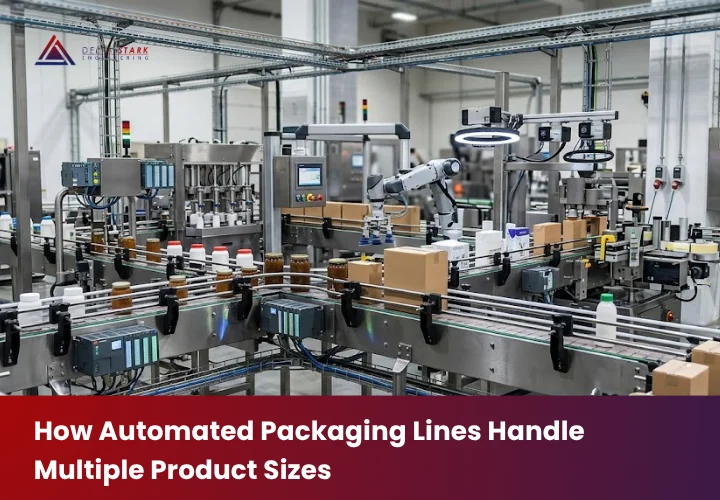
Modern manufacturing facilities often produce products in different sizes, weights, shapes, and packaging formats. Managing these variations manually can increase changeover time, labor requirements, and packaging errors. Automated packaging lines help manufacturers handle these variations by combining sensors, PLCs, servo systems, conveyors, machine vision, and recipe-based controls.
A flexible packaging system can identify different product formats and automatically adjust relevant machine settings. This allows manufacturers to improve production consistency while reducing unnecessary manual adjustments.
What Are Automated Packaging Lines?
An automated packaging line is a connected system that performs packaging operations with minimal manual intervention. Depending on the application, it can include conveyors, filling machines, sealing equipment, labeling systems, inspection machines, robotic handling systems, and palletizing equipment.
A typical automated packaging process may include:
- Product feeding and detection
- Product positioning
- Filling or dosing
- Sealing or closing
- Labeling
- Quality inspection
- Carton packing
- Palletizing
When multiple product sizes are handled, the automation system needs to identify the product and apply the correct parameters.
How Does the System Identify Product Sizes?
Product identification is an important part of flexible packaging automation. Sensors can detect product presence, position, height, and movement as items travel through the line.
Photoelectric sensors can detect products without physical contact, while machine vision can provide more detailed information about product characteristics. Barcodes, QR codes, and RFID can also be used when product identification requires unique information.
Once the product is identified, the PLC can select the appropriate production recipe. This recipe may contain settings for conveyor speed, filling quantity, sealing parameters, label position, and inspection requirements.
Automatic Recipe-Based Changeover
Recipe management allows a packaging machine to store predefined settings for different products.
For example, a line handling small and large containers may require different:
- Conveyor speeds
- Filling quantities
- Product spacing
- Sealing settings
- Label positions
- Gripper positions
- Carton dimensions
- Inspection parameters
When the required product is selected, the control system can load the corresponding recipe. Automated mechanisms can then adjust selected machine components.
This can reduce setup time and minimize the possibility of incorrect manual settings.
Role of Sensors in Packaging Automation
Sensors help the packaging line respond to actual production conditions. They can confirm whether a product is present, correctly positioned, or ready for the next process.
For example, products with different lengths may require different spacing. Sensors can detect their position and provide feedback to the PLC, allowing the conveyor to maintain appropriate product separation.
Accurate detection can help prevent collisions, jams, missed labels, and incorrect positioning.
Sensors can also coordinate different machines, ensuring that feeding, filling, sealing, inspection, and packing processes operate in the correct sequence.
Servo Systems for Precise Adjustments
Servo motors provide accurate control over position, speed, and movement. They are useful when packaging equipment needs to make precise adjustments for different product sizes.
A servo driven mechanism, for example, can adjust a filling nozzle, guide, sealing unit, or robotic gripper according to the selected product recipe.
This can improve repeatability and reduce the amount of manual adjustment required during product changeovers.
Machine Vision for Quality Inspection
Machine vision systems can inspect products and packaging while production is running. Depending on the application, a vision system can check product orientation, dimensions, label placement, package appearance, and other predefined quality criteria.
If the wrong product size enters the packaging process, the system can identify the mismatch and activate an alert or rejection mechanism.
This provides an additional quality-control layer and helps reduce the possibility of incorrect products being packaged.
Flexible Conveyor Systems
Conveyors are another important component when handling multiple product sizes. Different products need to move smoothly without tipping, colliding, or becoming stuck.
Adjustable guides, controlled conveyor speeds, sensors, and accumulation systems can help accommodate different product dimensions.
In advanced systems, automated changeover mechanisms can reposition guides and machine components according to the selected recipe. This allows manufacturers to switch between product formats with less manual intervention.
Benefits of Multi Size Packaging Automation
Reduced Changeover Time
Automated recipes and adjustable machine components can reduce the time required to switch between product formats.
Improved Consistency
Programmed machine settings help maintain repeatable packaging processes across different production batches.
Fewer Manual Errors
Automatic product identification and parameter selection can reduce incorrect machine settings.
Greater Production Flexibility
One flexible packaging line can handle multiple product variants instead of requiring separate equipment for every size.
Better Production Visibility
Connected automation systems can provide information about production rates, machine status, rejects, and downtime, helping manufacturers identify improvement opportunities.
What Should Manufacturers Consider?
Before implementing an automated packaging line, manufacturers should evaluate product dimensions, weight, packaging materials, production speed, number of product variants, changeover frequency, inspection requirements, floor space, and future production needs.
The system should also be designed for safe operation, maintenance, and future expansion. Proper integration between conveyors, sensors, PLCs, robots, vision systems, and packaging machines is essential for reliable performance.
Delta Stark and Packaging Automation
For manufacturers handling multiple product formats, packaging automation should be designed around the complete production process. Delta Stark Engineering provides industrial automation, robotics, factory equipment, and customized manufacturing solutions for industrial applications.
An application-focused automation approach can help integrate product handling, conveyor systems, robotic operations, packaging processes, and inspection equipment into a coordinated production line.
Conclusion
Automated packaging lines can handle multiple product sizes by combining sensors, PLCs, servo systems, machine vision, flexible conveyors, and recipe based controls. These technologies allow manufacturers to identify product variants and adjust machine settings with greater speed, accuracy, and consistency.
As product variety increases, flexible packaging automation can help reduce changeover time, minimize manual errors, improve packaging quality, and make better use of existing production infrastructure.
With the right automation and engineering approach, manufacturers can develop packaging lines that are flexible enough to handle multiple product sizes while providing a strong foundation for efficient and scalable manufacturing.